
General Election
This year’s election has ended. See the results below.
- 00Days
- 00Hours
- 00Minutes
- 00Seconds
Election Results
A total of 869 votes were cast in this season’s election.
Special Assessment
The Special Assessment passed with 762 votes, representing 89.6% approval. The $3,000 Special Assessment will be assessed (billed) to each property on July 1, 2026.
CC&R Amendments
- The amendment regarding Seasonal Hours for the Rec Hall and Office passed with 653 votes, representing 79.7% approval.
- The amendment to align the Special Election schedule with the seasonal election passed with 689 votes, representing 86% approval.
- The amendment to increase the number of petition signers from 100 to 20% of the membership passed with 577 votes, representing 73.5% approval.
Board of Directors Election Results
Dan Boarders received 710 votes.
Sandra Magnan received 692 votes.
Jayne Tiffany received 643 votes.
Thank you to all who participated and voted in this year’s election.
Election Dates and Information
This section highlights general election information and Frequently Asked Questions regarding the election process.
Voting Dates and Times
- Electronic voting opt-in closes Jan 23.
- Paper ballots will be distributed starting at 8AM Jan 30. This includes distribution to Roadhaven resident mailboxes and paper ballots in the USPS mail pick up for property owners outside of Roadhaven.
- Paper and electronic voting starts Jan 30 at 8AM, and closes March 09 at 3PM.
- In-person paper ballots can be dropped in the ballot box located in the Main Office lobby Monday-Friday 8A-3P, they can also be placed in the in-park mail drop.
- For electronic voting, residents will receive an email with the subject line “Roadhaven Resort Annual Election Ballot” from Roadhaven using Election Buddy on Jan 30, 8AM.
VOTING CLOSES March 9 at 3PM
Announcement of Results
- Election results will be announced at the Annual General Meeting (AGM), Tues., Mar 10 at 7PM in the Rec Hall.
- The results will also appear on this Election page at 8AM Wed., Mar 11. and in the following Friday’s newsletter.
Changes Effective On
- Newly elected Board members will take office immediately after the AGM.
- If passed, CC&R changes and the special assessment would be effective on July 01, 2026.
Help with Voter Registration
If you are unsure if you are registered to vote or need general assistance, please email board@roadhaven.com
How many votes to pass?
Roadhaven has 1,060 lots. This means 1,060 possible votes in an election.
This includes paper and electronic ballots. When the community wants to change (amend) the CC&Rs or pass a special assessment, two things have to happen:
1. Quorum. A quorum must be met. Meaning, enough people have to vote.
2. Approval majority. Meaning, enough of those votes are “yes.”
TO APPROVE A SPECIAL ASSESSMENT:
(CC&Rs sections 6.4 and 6.5)
First Voting Round
Of the total membership, 60% must submit a vote (quorum). With 1,060 lots, that means at least 636 ballots must be received. Then, two-thirds of the ballots cast must be “yes” for it to pass (approval majority). If fewer than 636 ballots are submitted, quorum is not reached and the vote fails due to insufficient participation.
Second Voting Round (if needed)
If quorum is not reached in the first round of voting, a second voting round may be held. In that round, only 30% of the membership must submit ballots, which would be 318 ballots.
Again, two-thirds of the ballots cast must be “yes” to pass the special assessment.
TO CHANGE THE CC&RS (AMENDMENT):
(CC&Rs section 8.3)
- More than 50% of all eligible (in good standing) members have to vote. In this example, we will assume everyone is in good standing, and all ballots are valid. 50% of 1,060 (total lots) is 530. So that means at least 531 (50% + 1 lot) must vote.
- Then, two-thirds of the people who voted (in this example, 354 is two-thirds of the 531) must vote “yes” on the item for the CC&R amendment to pass.
This is why every vote matters. No matter what your vote is, be sure to submit your paper or electronic ballot by March 09 at 3PM (AZ time).
Click here to download the PDF.
Length of Board Term
Board Terms are 3 years and directors are eligible to run 3 consecutive terms. See Bylaws section 3.3 Term of Office.
Meet the Board Candidates
- Tues., Jan. 13 – Meet the Candidates during Coffee Talk in the Rec Hall at 8AM.
- Tues., Jan. 20 Candidates Forum in the Rec Hall at 7PM
- Click here to view candidate’s bios or scroll down
2026 Electronic Ballot Walkthrough
2026 Paper Ballot Walkthrough
Proposed Changes to CC&Rs
In this section you will find the proposed changes to the current CC&Rs.
View CC&R Descriptions | View Special Assessment Description
Petition Signature Increase
Petition Signature Requirement – CCR Article 8, Section 8.3
What is being proposed?
This amendment would increase the number of signatures required to submit a petitioned amendment from 100 lots to 20% of all lots.
Why is this being proposed?
This change is intended to ensure that petitioned amendments reflect broad community support before triggering the amendment process. Requiring signatures from 20% of all lots helps confirm that a proposed change is of interest to a meaningful portion of the membership, while still preserving residents’ ability to bring forward amendments. This approach promotes consistency, reduces the likelihood of frequent or narrowly supported petitions, and helps the Association manage elections and administrative resources responsibly.
THIS IS NOT THE Actual ballot language.
Special Elections
Timing of Petitioned Amendments – CCR Article 8, Section 8.3
What is being proposed?
This amendment would require resident-petitioned amendments to be submitted to the Secretary by December 1 in order to be placed on the regular seasonal election ballot, rather than triggering a separate special election, in accordance with the existing CC&R election calendar.
Why is this being proposed?
This amendment is intended to create a more efficient, consistent, and cost-effective election process. By requiring petition-initiated amendments to be voted on during the regular seasonal election, the Association can avoid the expense, administrative burden, and confusion of holding separate special elections. This approach ensures all proposed amendments follow the same established election timeline, provides residents with clear notice and ample time to review ballot materials, and supports higher participation by aligning votes with the annual election when more owners are engaged.
THIS IS NOT THE Actual ballot language.
Rec Hall and Admin Hours
Seasonal Resort Hours – CCR Article 3, Section 3.2 F
What is being proposed?
This amendment would remove the Rec Hall and Administration (Main Office) from seasonal hours language.
Why is this proposed?
The Rec Hall must be temperature-controlled year-round to protect parquet flooring, audiovisual and network equipment, and the security office, and it remains unlocked during the summer so residents can access the AED, emergency 911 phone and restrooms. Because the building is already cooled and open for these purposes, allowing limited resident use provides a comfortable indoor gathering space without adding operating costs or increasing utility expenses.
The Administration (Main Office) already operates year-round, and this amendment does not change current office hours, staffing levels, services, or increase operating costs. Instead, it aligns the CC&Rs with how the office already functions and removes outdated seasonal language. The amendment also allows modest operational flexibility for routine needs such as staff training or internal meetings, without requiring future CC&R amendments.
THIS IS NOT THE Actual ballot language.
Video of ballot box being secured:
Special Assessment for Deferred Maintenance
Deferred Maintenance: Background and Path Forward
As we began developing the upcoming summer projects list, we reviewed the Association’s Reserve Studies from 2017 and 2023 to better understand which major repairs and replacements had been done and which were coming due. That review quickly revealed a larger issue.
Many items identified in prior years had been deferred, temporarily repaired, or replaced with equipment that was already near the end of its useful life. What initially appeared to be individual maintenance items was, in reality, a growing backlog with no long-term strategy in place to fully address it.
As we dug deeper, it also became clear that the long-standing approach of keeping quarterly assessment increases low year after year contributed to this situation. While well-intentioned, that model did not generate enough funding to keep pace with aging infrastructure or adequately support the Reserve Fund.
Together, these factors underscore the need for a thoughtful, comprehensive approach to addressing deferred maintenance. The goal now is to clearly present the current condition of the Association’s assets, outline viable funding options, and support informed decision-making that protects the community’s safety, financial stability, and long-term value.
For more discussion on the community’s deferred maintenance and proposed path forward, we encourage you to attend the upcoming Town Hall meetings hosted by the Finance Committee on January 8th, February 5th, and March 5th at 7:00 pm in the Rec Hall.
Project Totals By Year:
Year 1
- Isolation Valves $150,000.00
- Fire Hydrant Replacement $60,000.00
- Network Switches $31,000.00
- Salt Cell System Phase II $22,360.00
- Phase I and Phase II Sand Filters $18,045.00
- Reseal Streets $185,968.00
- Heat Pumps, Gas Packs, Mini Splits $96,500.00
- Boom Lift $30,000.00
- Aerator $45,000.00
- Greens Mower $23,000.00
- Block Wall Assessment $14,000.00
- Culvert Repairs $340,000.00
- Cameras and Cabling $90,000.00
Year 2
- Phase I Aquatic Building Moisture Barrier $100,000.00
- Golf Course Irrigation Timers $25,000.00
- Rec Hall Ice Machine and Condenser $8,000.00
- Concrete Repairs -Common Areas/Canal $12,000.00
- Exterior Paint Common Area Buildings $76,289.00
- Windows and Screens $24,005.00
- Phase II Pool/Spa Resurface $63,800.00
- Phase II Deck $45,000.00
- Chemical Spray Tank for Golf Course $10,000.00
- Water Fountain Replacements $9,000.00
- Seed Spreader $8,425.00
- Interior Paint $10,325.00
- Tee Box Screen Replacement $7,478.00
- Common Area Flooring – Carpet/Vinyl $29,271.40
- Bridge Structural Evaluations $15,000.00
- Used Golf Carts $38,874.00
- Restaurant Equipment $75,381.00
Year 3
- #8 Lake Liner/Asphalt/Concrete $1,200,000.00
Contingency and 3 Year Total
Contingency $316,278.60
Grand Total $3,180,000.00
Project Descriptions and Rationale
Isolation Valves & Fire Hydrants
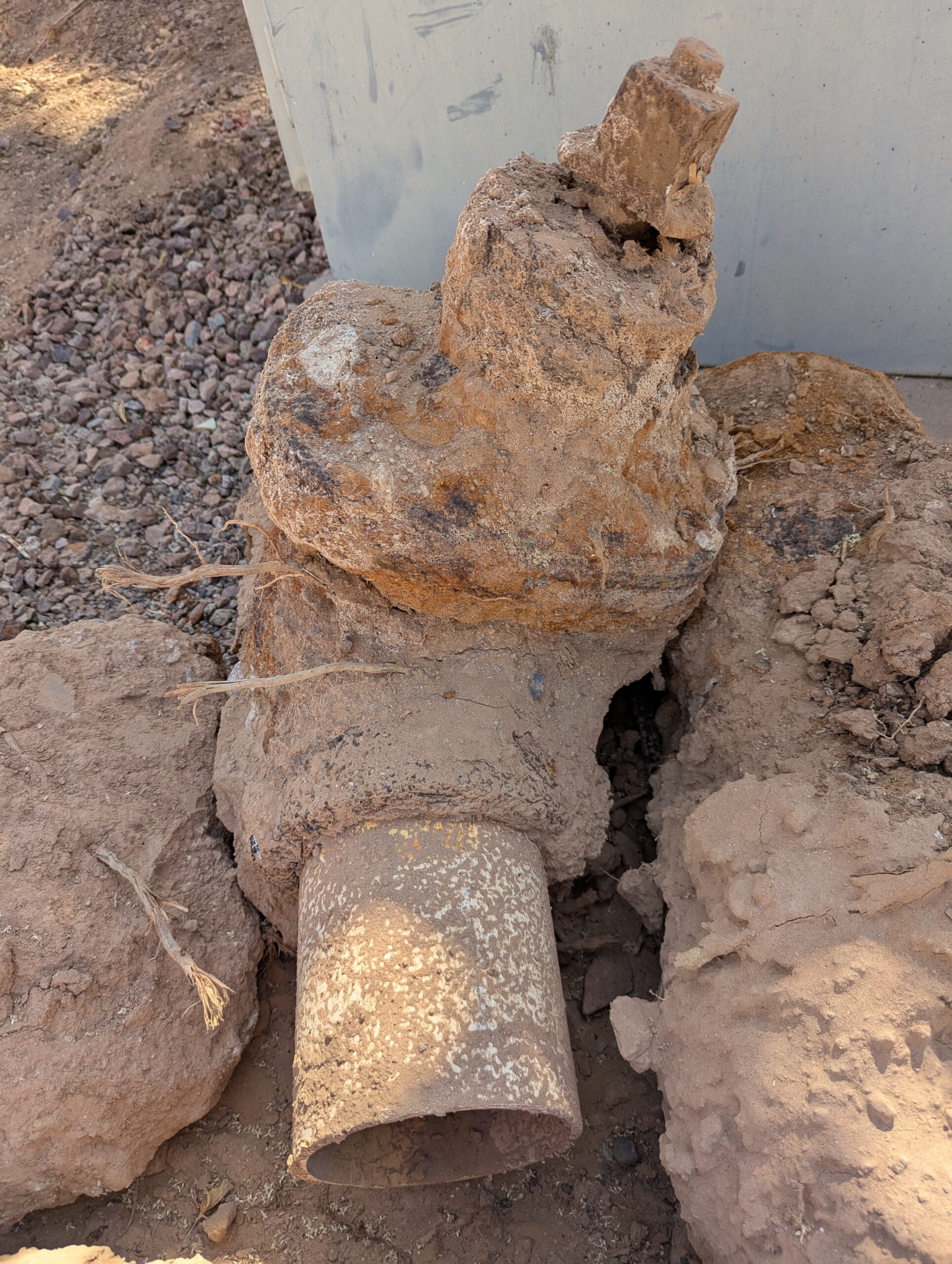
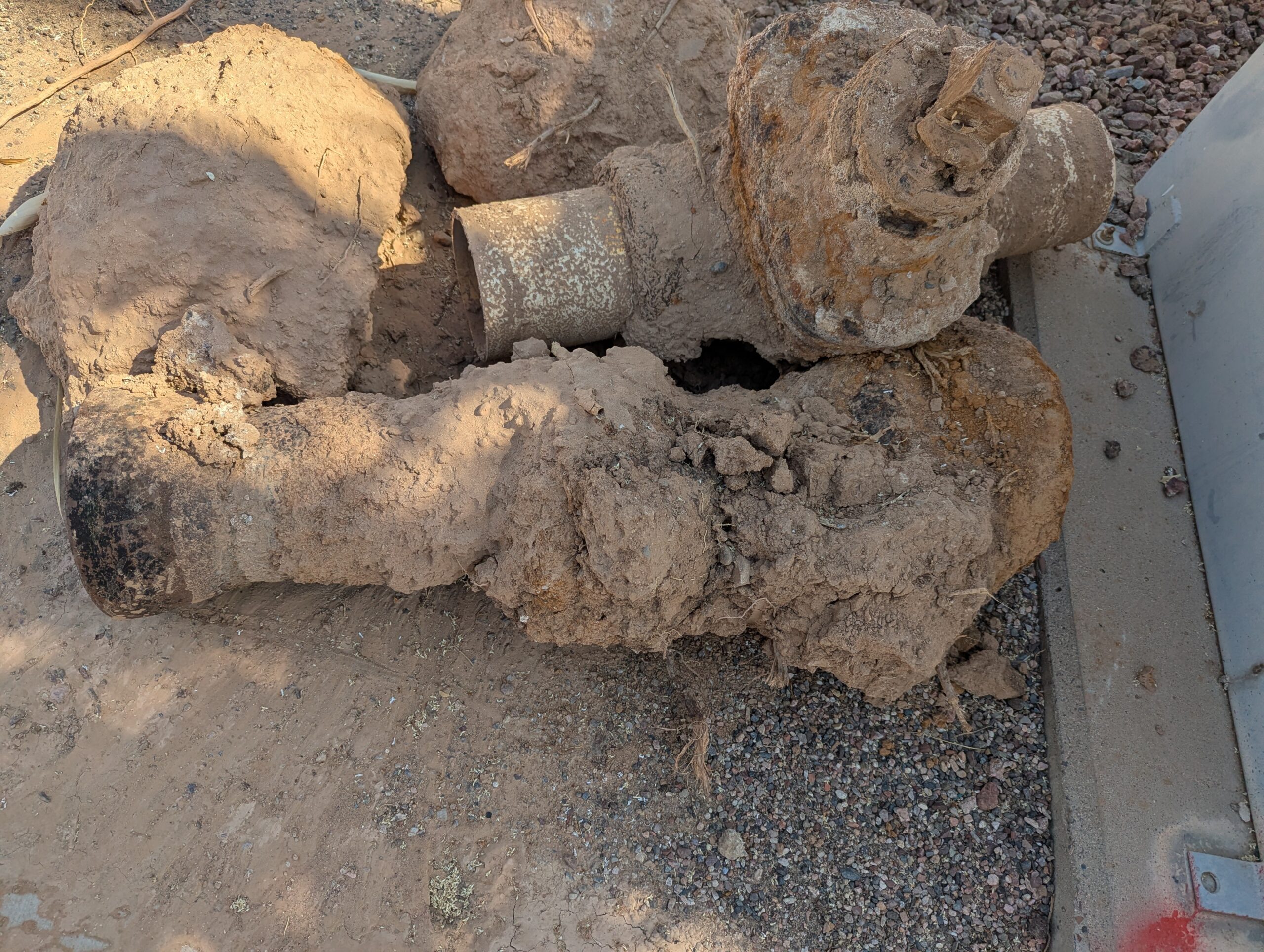
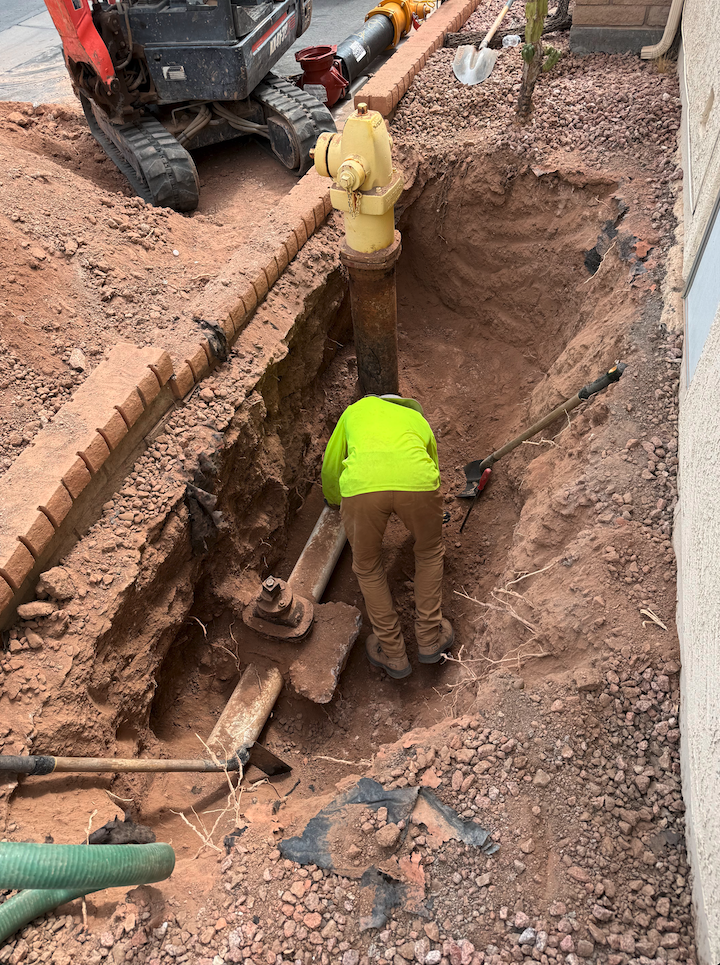
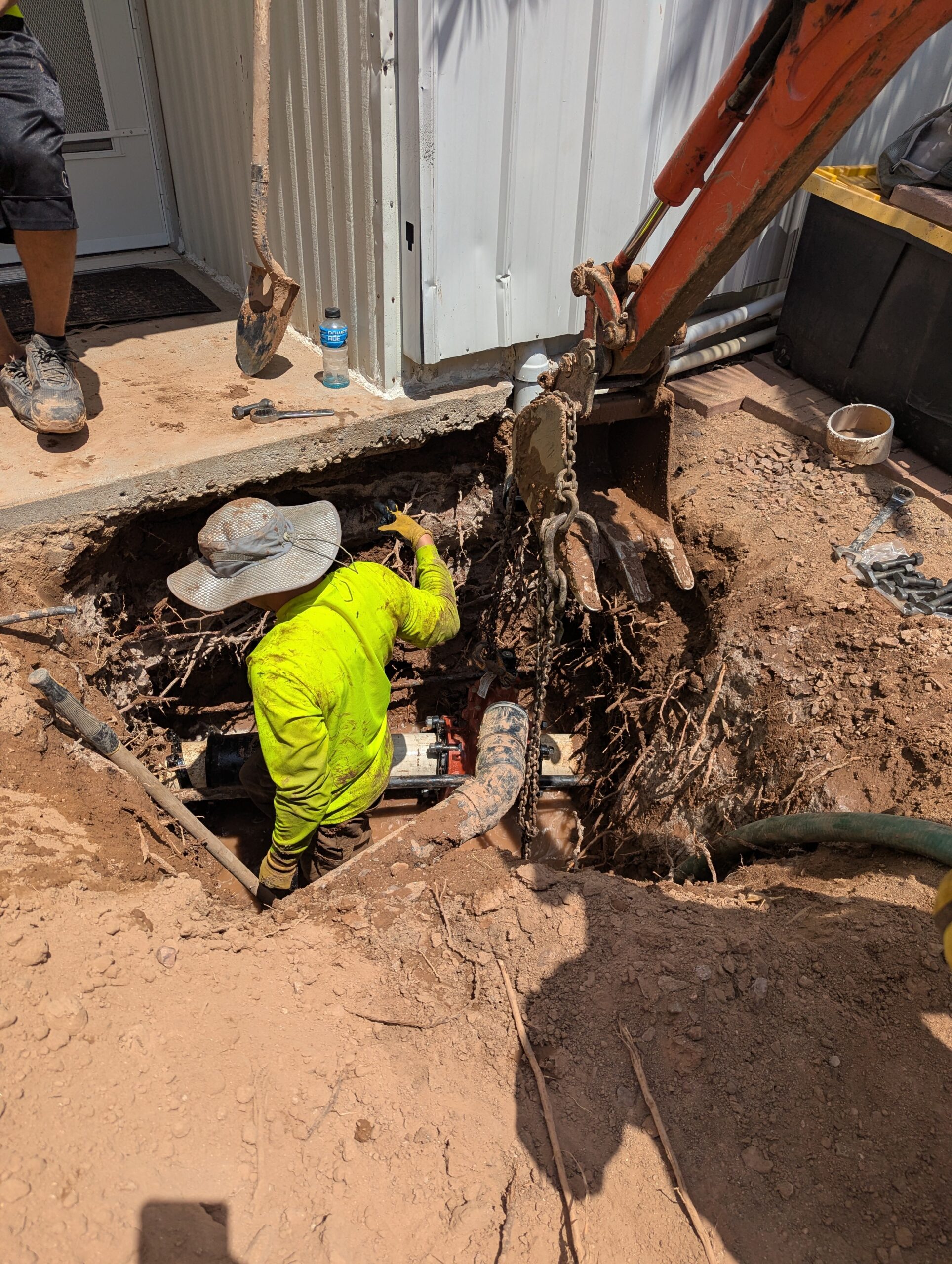
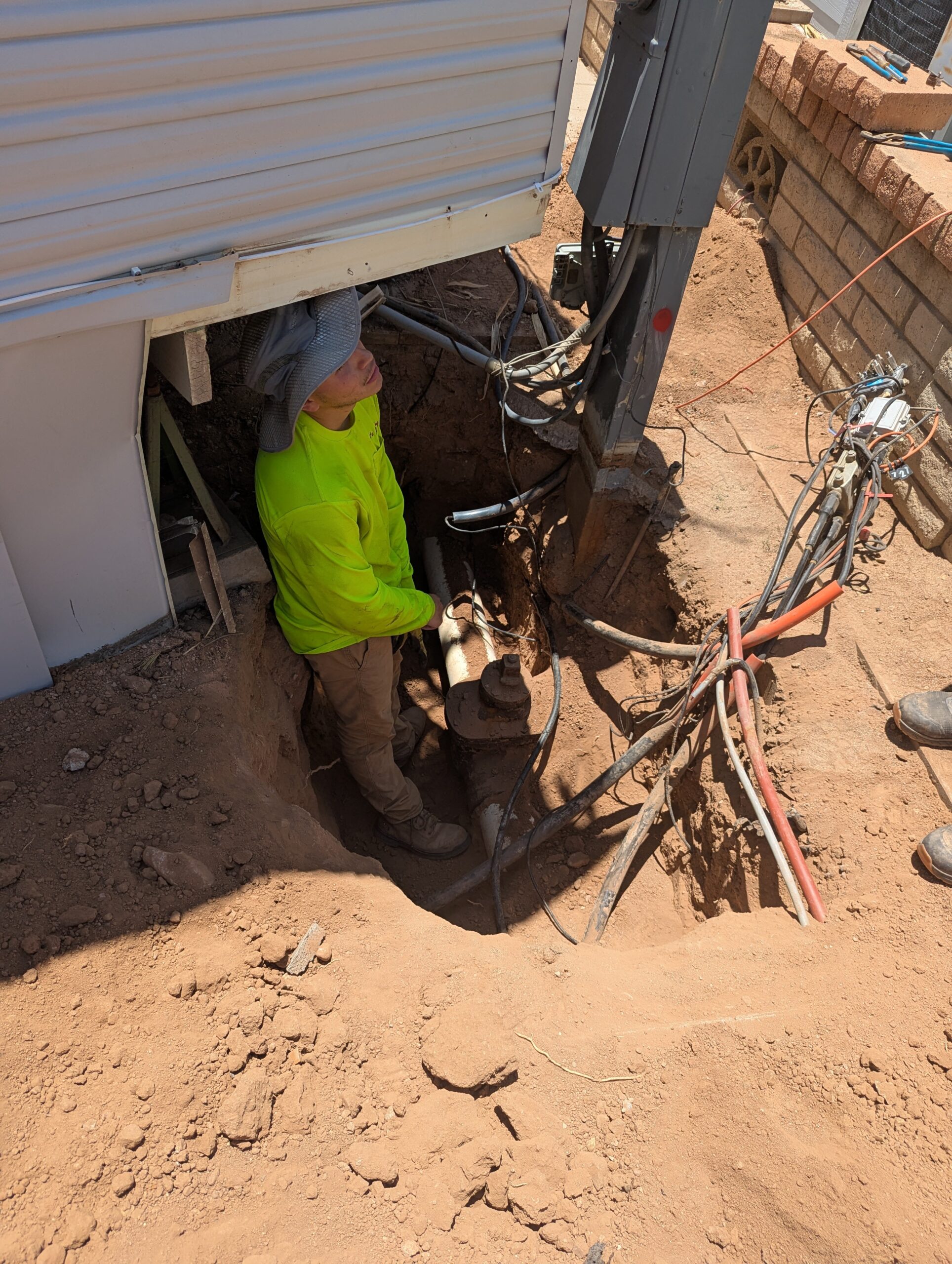
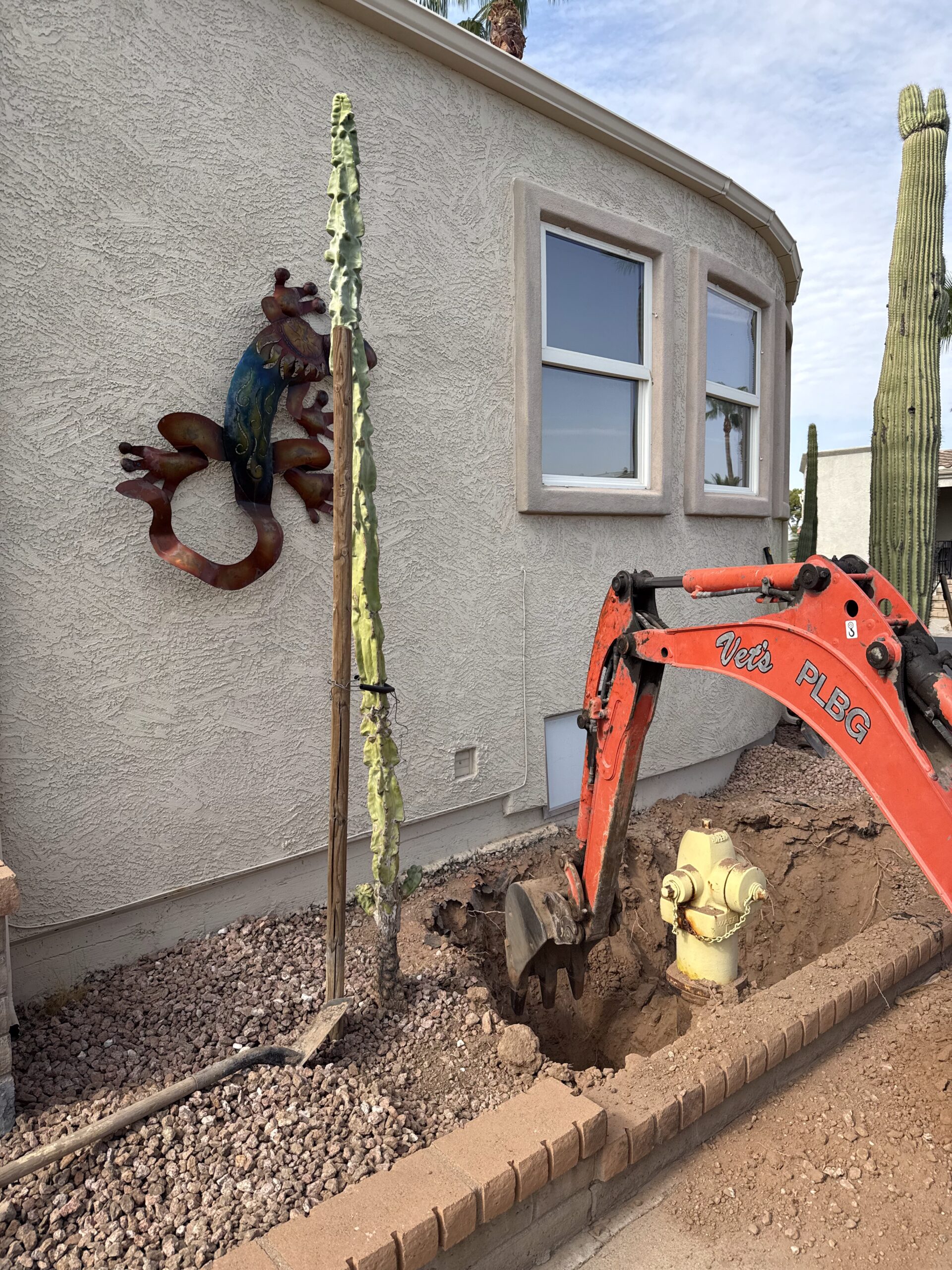
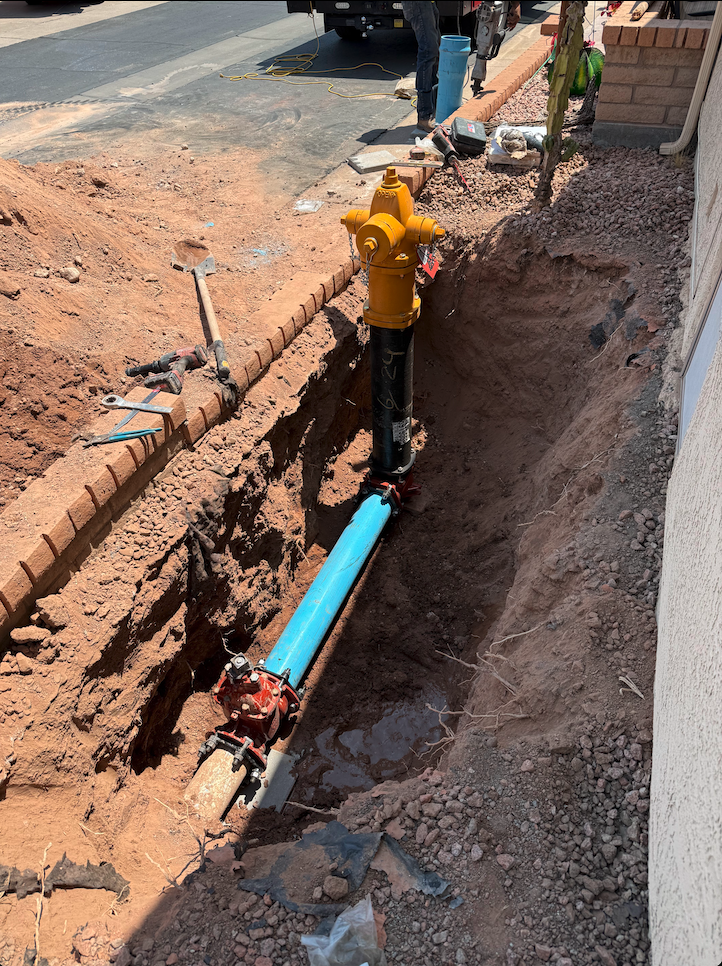
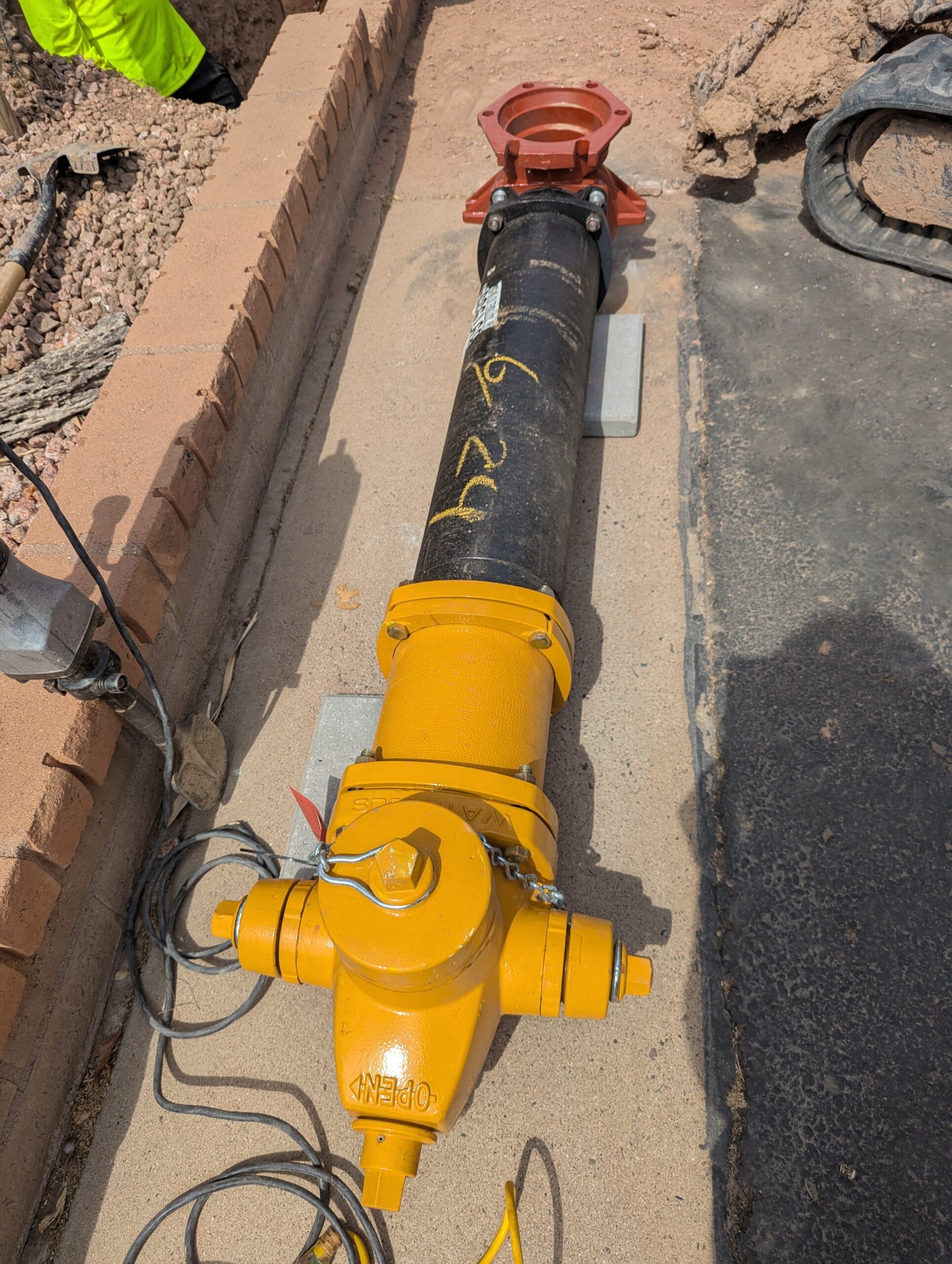
Click an image to enlarge.
Isolation valves control water flow so repairs can be made without shutting off large areas. We have 100+ valves, and recent inspections identified 20 failed or failing valves and 3 failing fire hydrants. Replacement costs vary based on size, depth, and location, as some are buried under concrete, patios, or structures.
Costs:
- Isolation Valves $150,000.00
- Fire Hydrant Replacement $60,000.00
Network Switches
Roadhaven utilizes network switches in most of its buildings throughout the resort. These network switches serve as the critical interface connecting the resort’s fiber optic network to various devices, including computer workstations, WiFi networks, security cameras, gate management systems, and business-line VOIP phones.
Most of our switches are past their end of life and no longer receive security updates, increasing the risk of failures and cyber events. The system was maintained over time without a consistent design, making it difficult to troubleshoot and manage. Replacement and standardization are needed for reliability and security.
Costs: Network Switches $31,000.00
Camera Systems
Over the past decade, more than 140 cameras have been installed throughout the resort. Because they were added gradually over many years, the system now includes a mix of equipment—ranging from older analog cameras to newer digital models. This staggered approach has created inconsistencies in technology, cabling, and platforms.
As a result, the system lacks standardization, and several critical cameras—including those at the Broadway Gate and the Woodshop—are currently offline. Maintenance is also more difficult due to limited documentation and the variety of equipment used.
Transitioning to a single, standardized platform and connection type will greatly improve system reliability, streamline repairs, and enhance overall security coverage for the community.
Costs: Cameras and Cabling $90,000.00
Golf Course Equipment
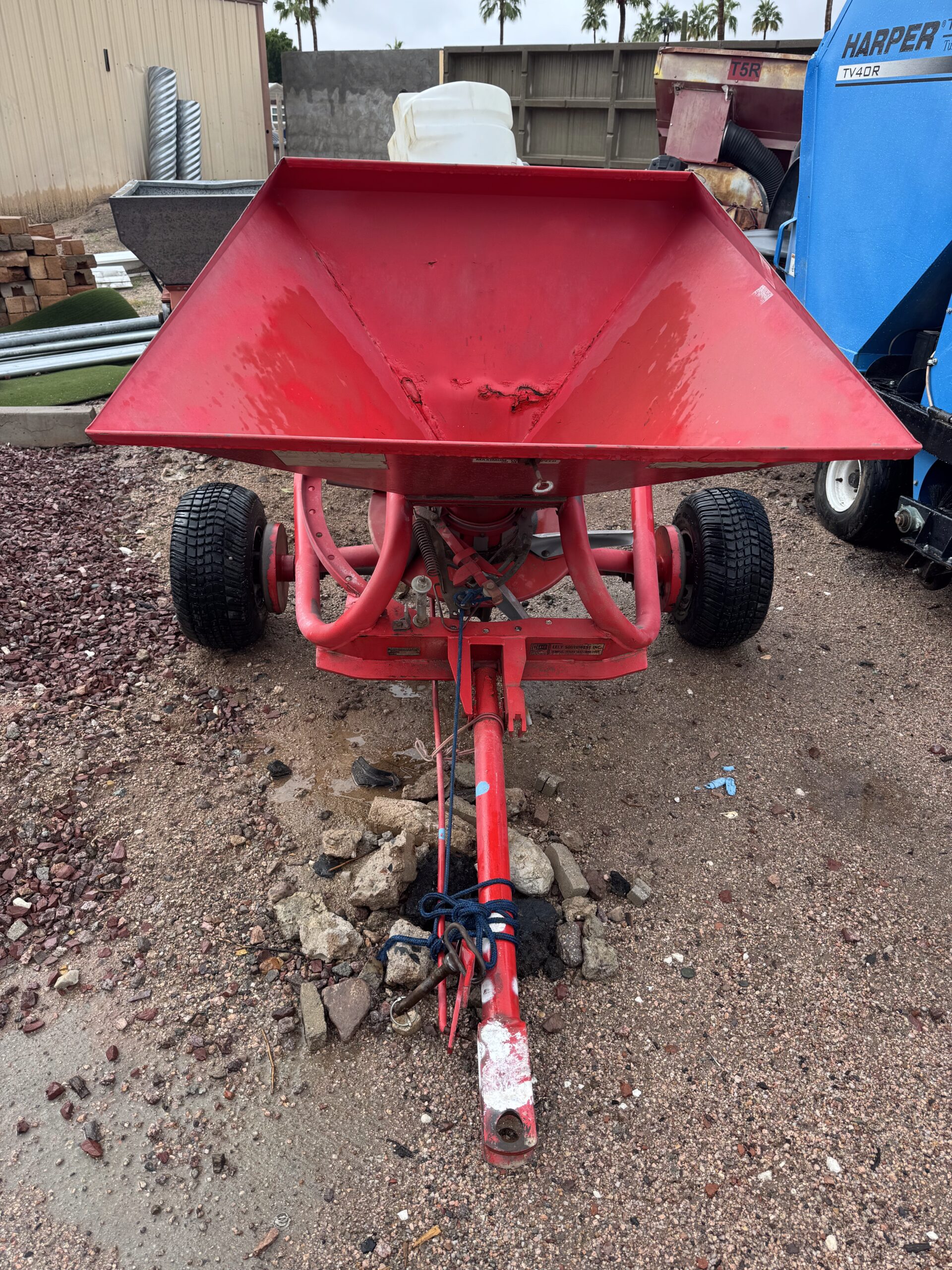
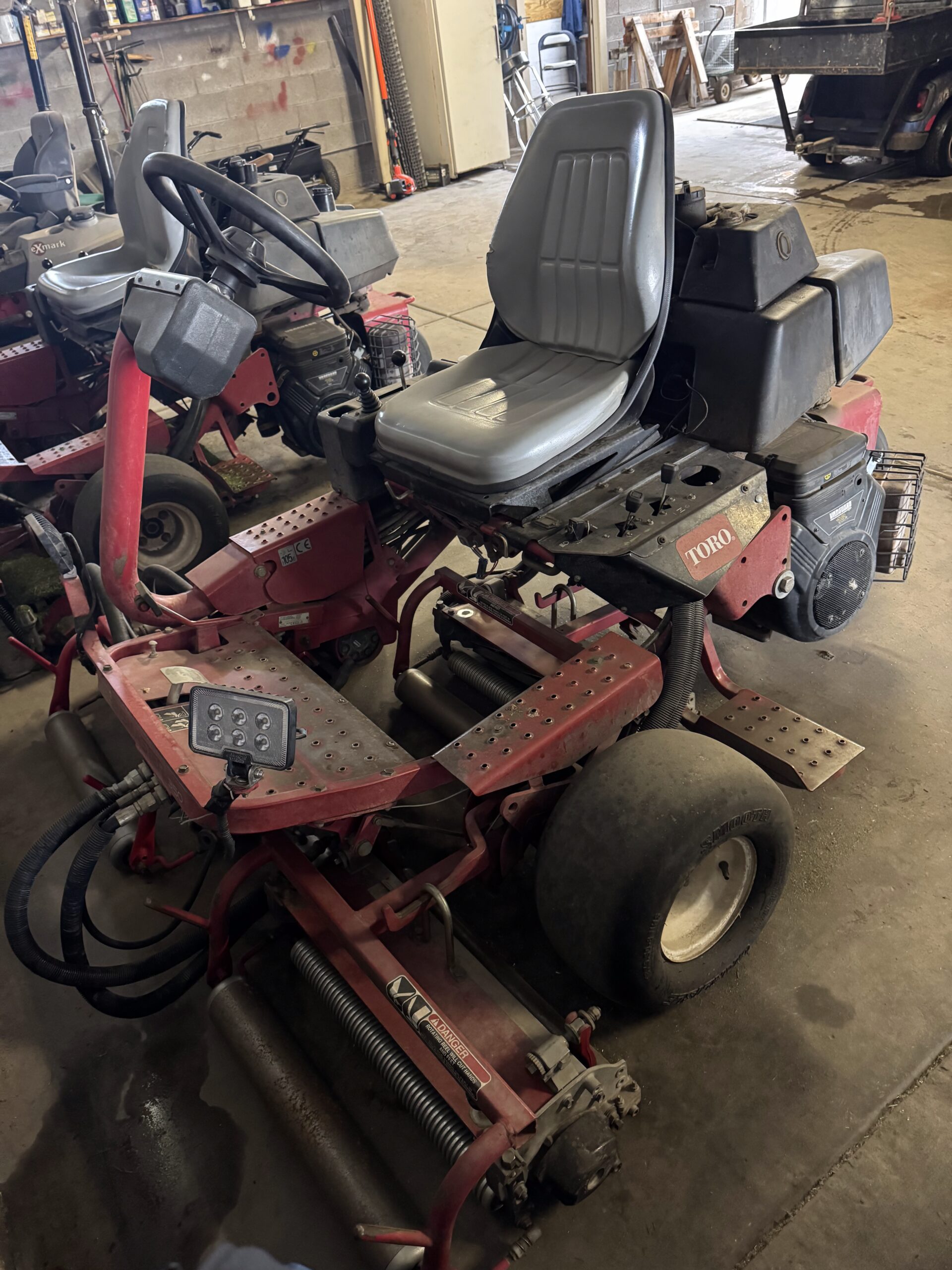
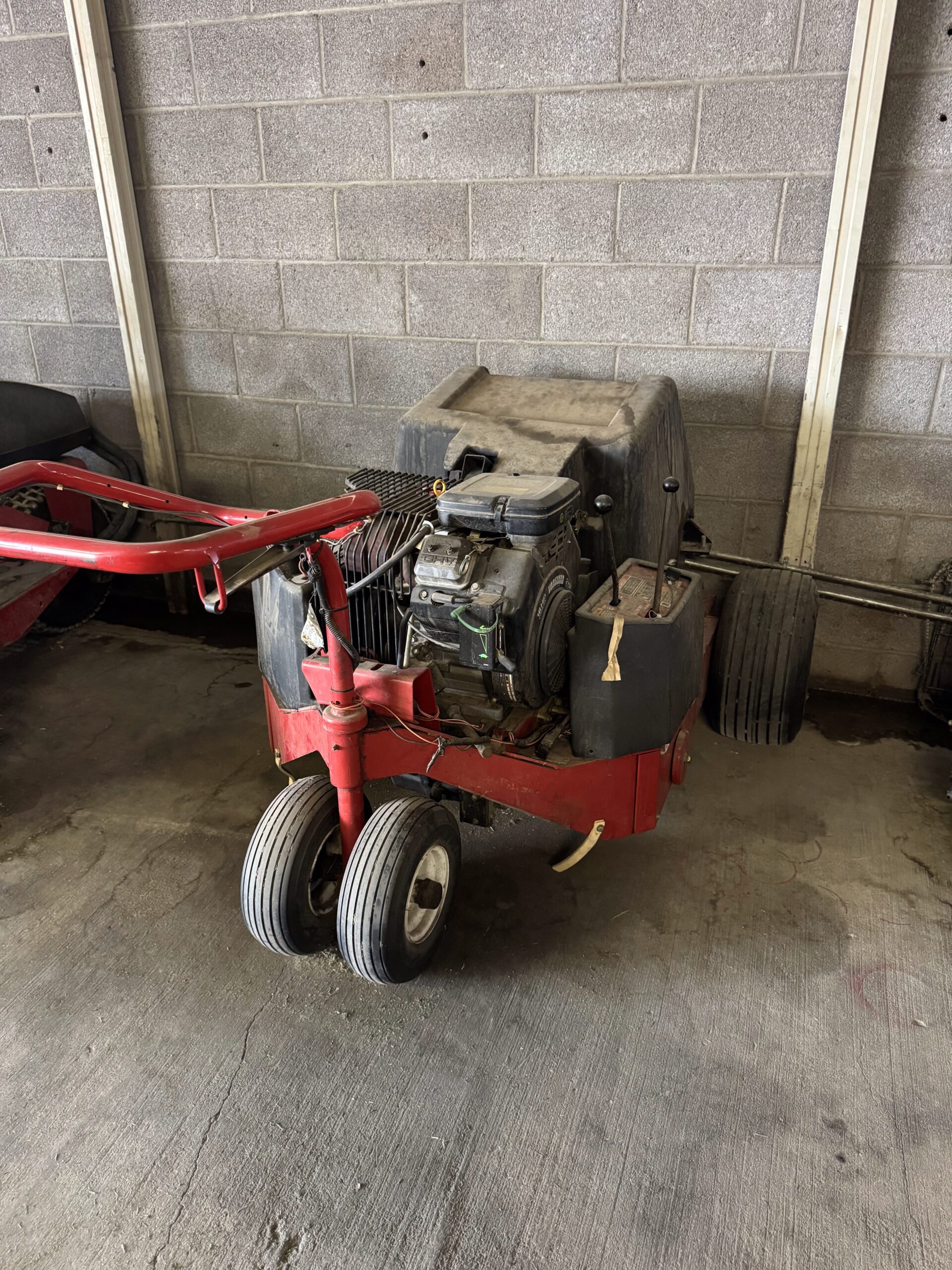
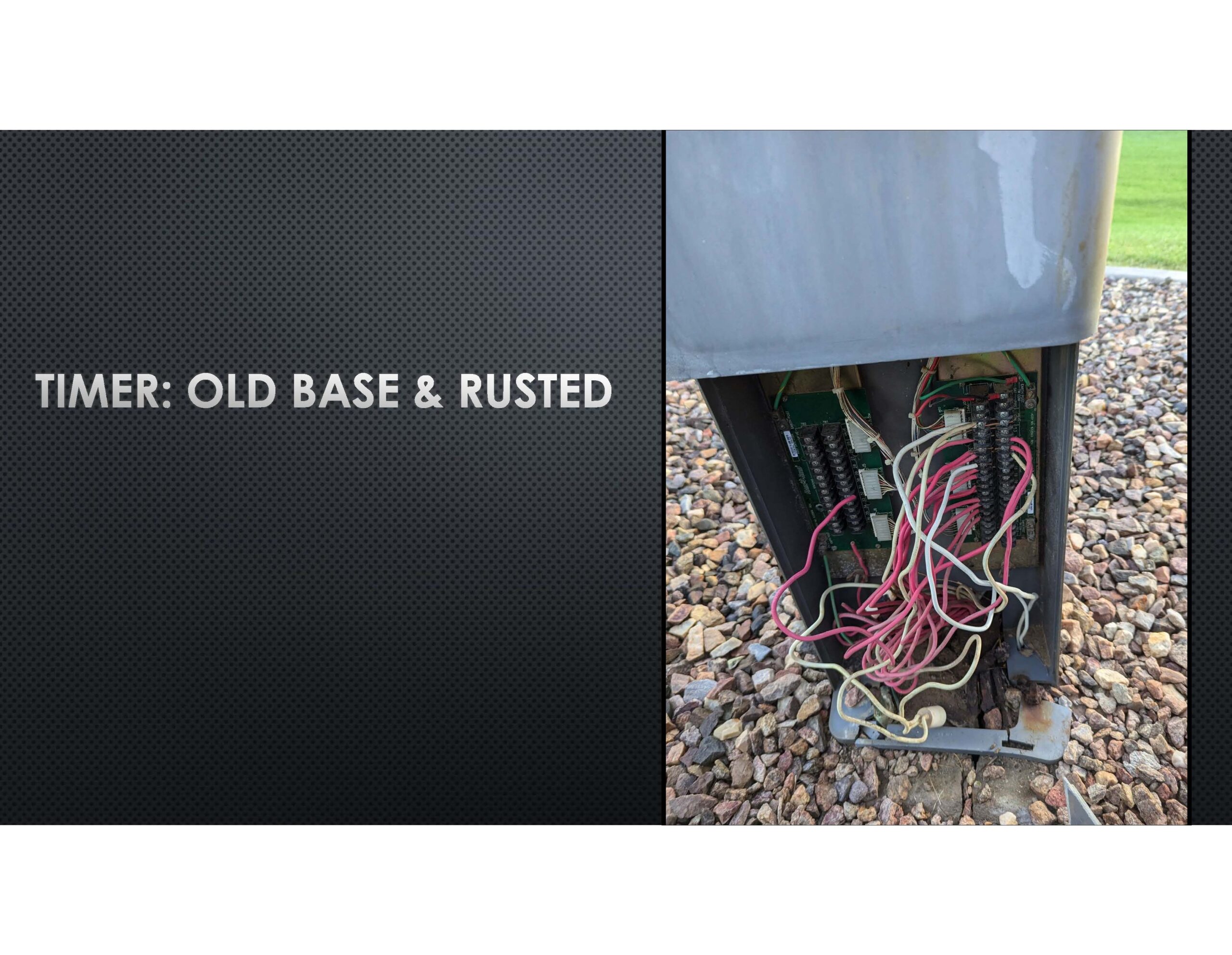
Click an image to enlarge.
Several critical pieces of equipment are past useful life:
- Seed/fertilizer spreader is rusted, patched, and unsafe to operate.
- Aerator is failing and parts are unavailable.
- Greens mower has over 5,800 hours and failing hydraulics.
- Only one 60-gallon spray tank is in use; a 150-gallon tank is needed for safe chemical separation.
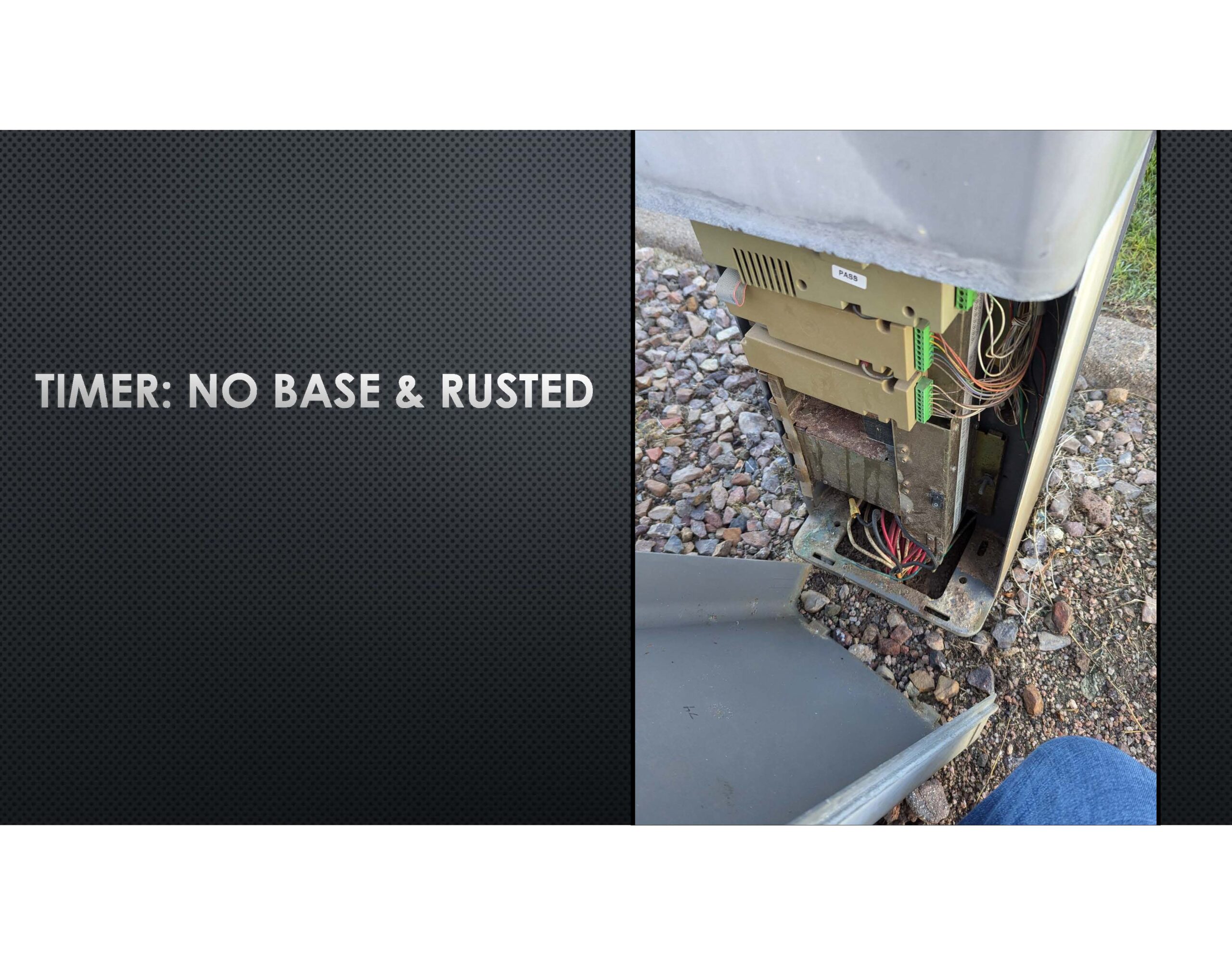
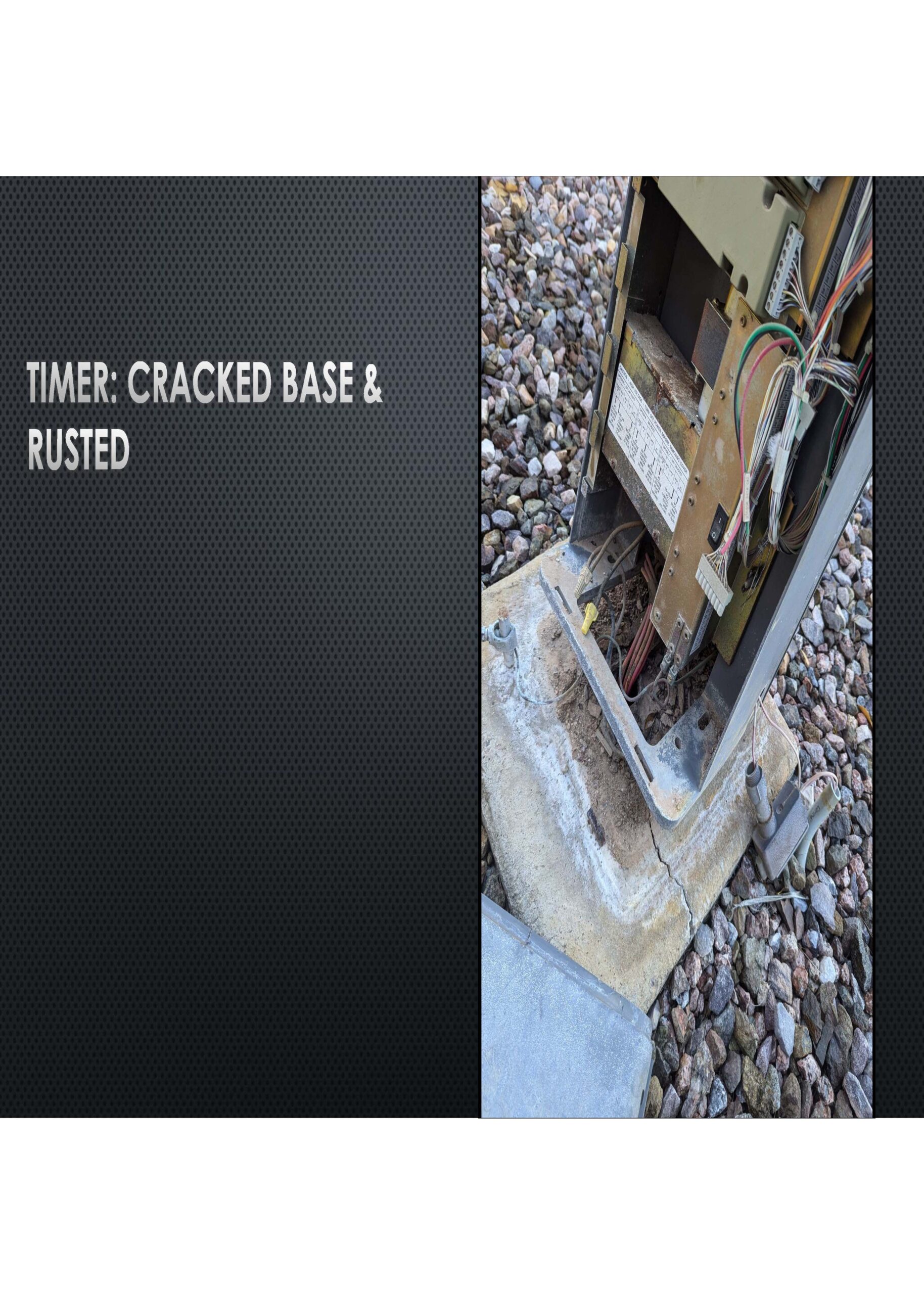
- Five of seven irrigation timers are past lifespan, rusted, have no concrete base, and exposed to moisture.
Costs:
- Seed Spreader $8,425.00
- Aerator $45,000.00
- Greens Mower $23,000.00
- Chemical Spray Tank for Golf Course $10,000.00
- Golf Course Irrigation Timers $25,000.00
Tee Box Screens
Tee box screen nets protect golfers and nearby property from errant golf balls. When nets are damaged they are more likely to fail on impact, increasing the risk of serious injury or property damage. Keeping these nets in good working condition reduces liability risk for the Association and ensures a safer experience for both golfers and residents. Failing metal frames have been repaired.
Costs: Tee Box Screen Replacement $7,478.00
Culverts (Inuit Street)
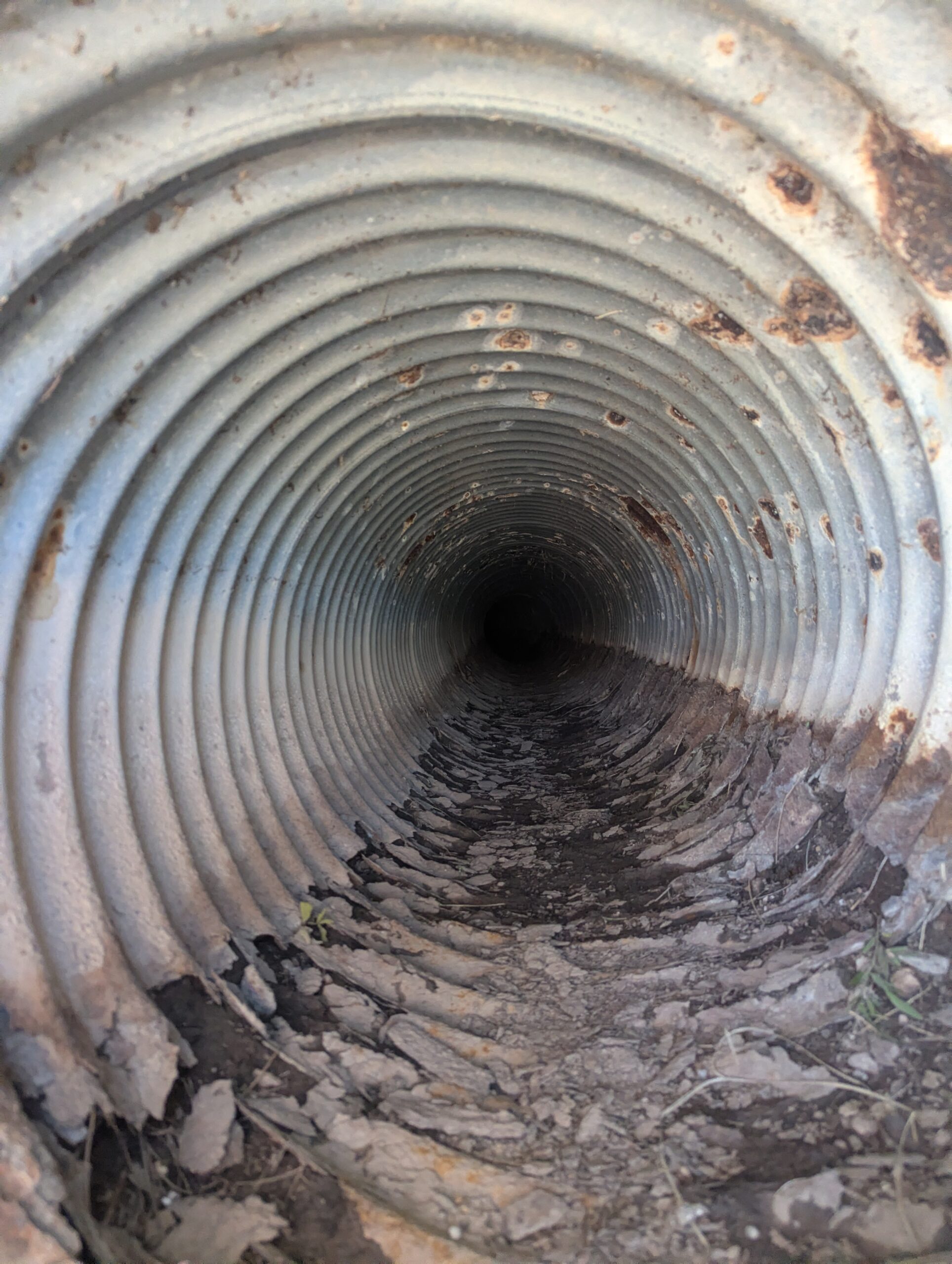
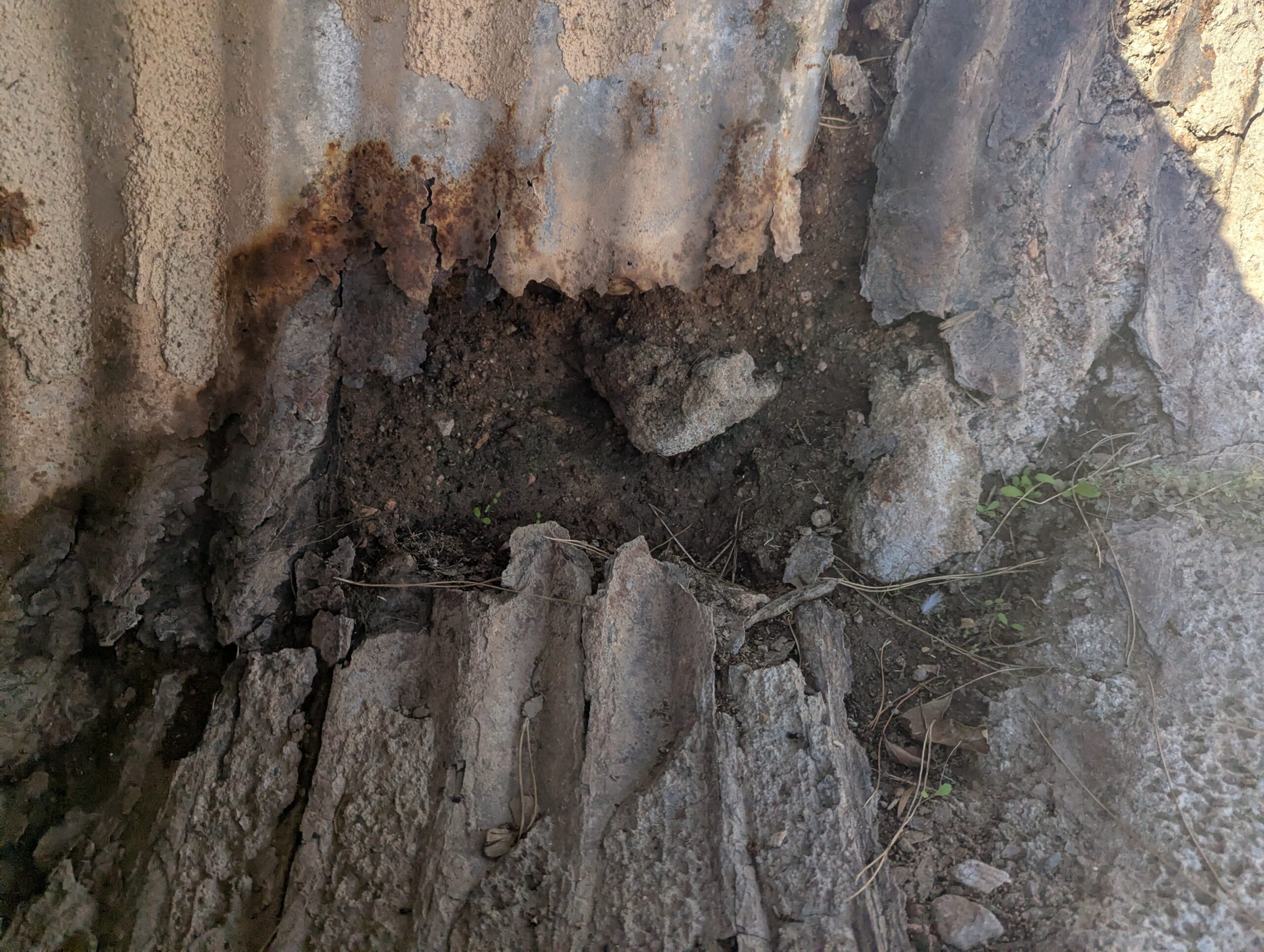
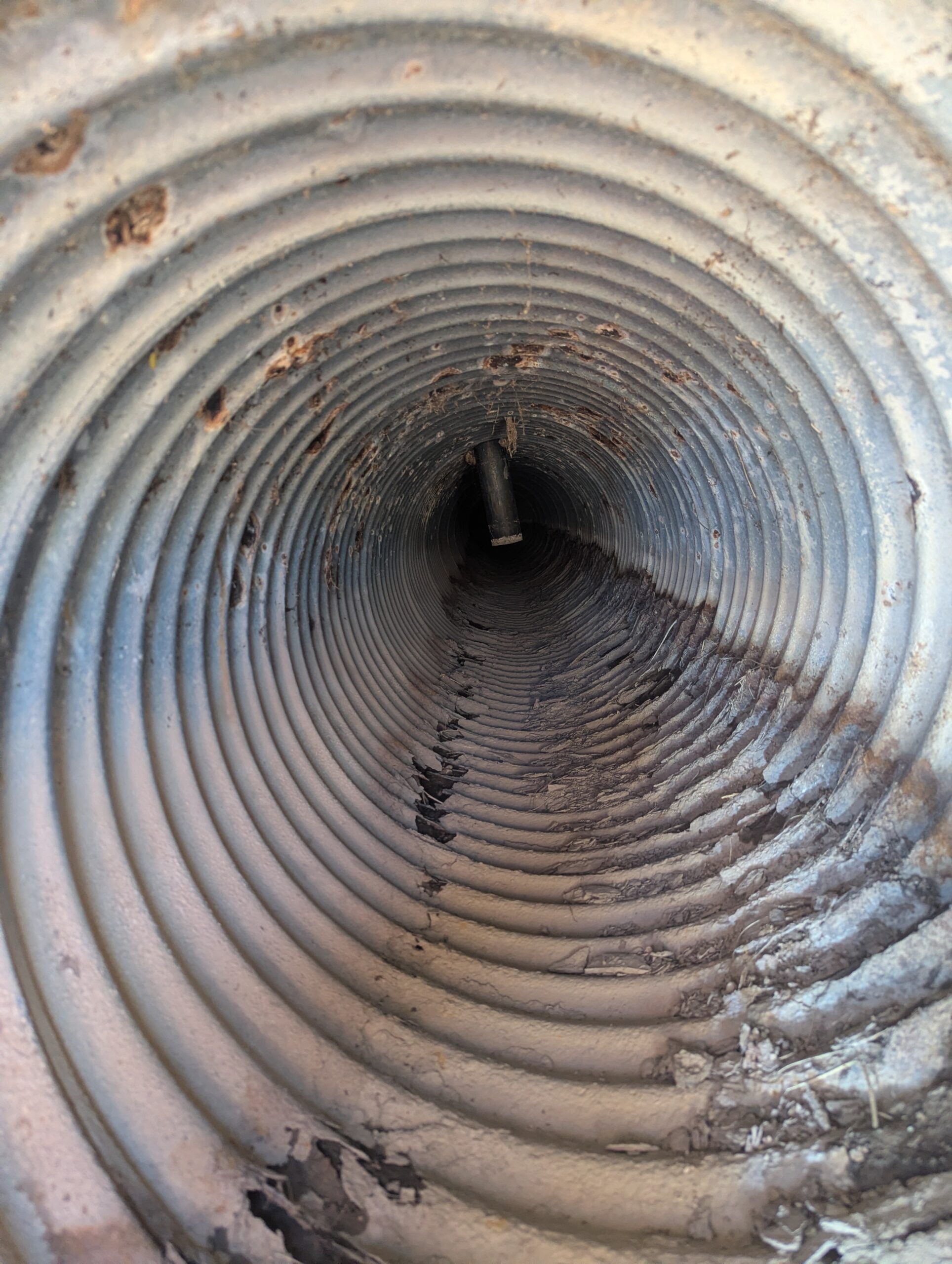
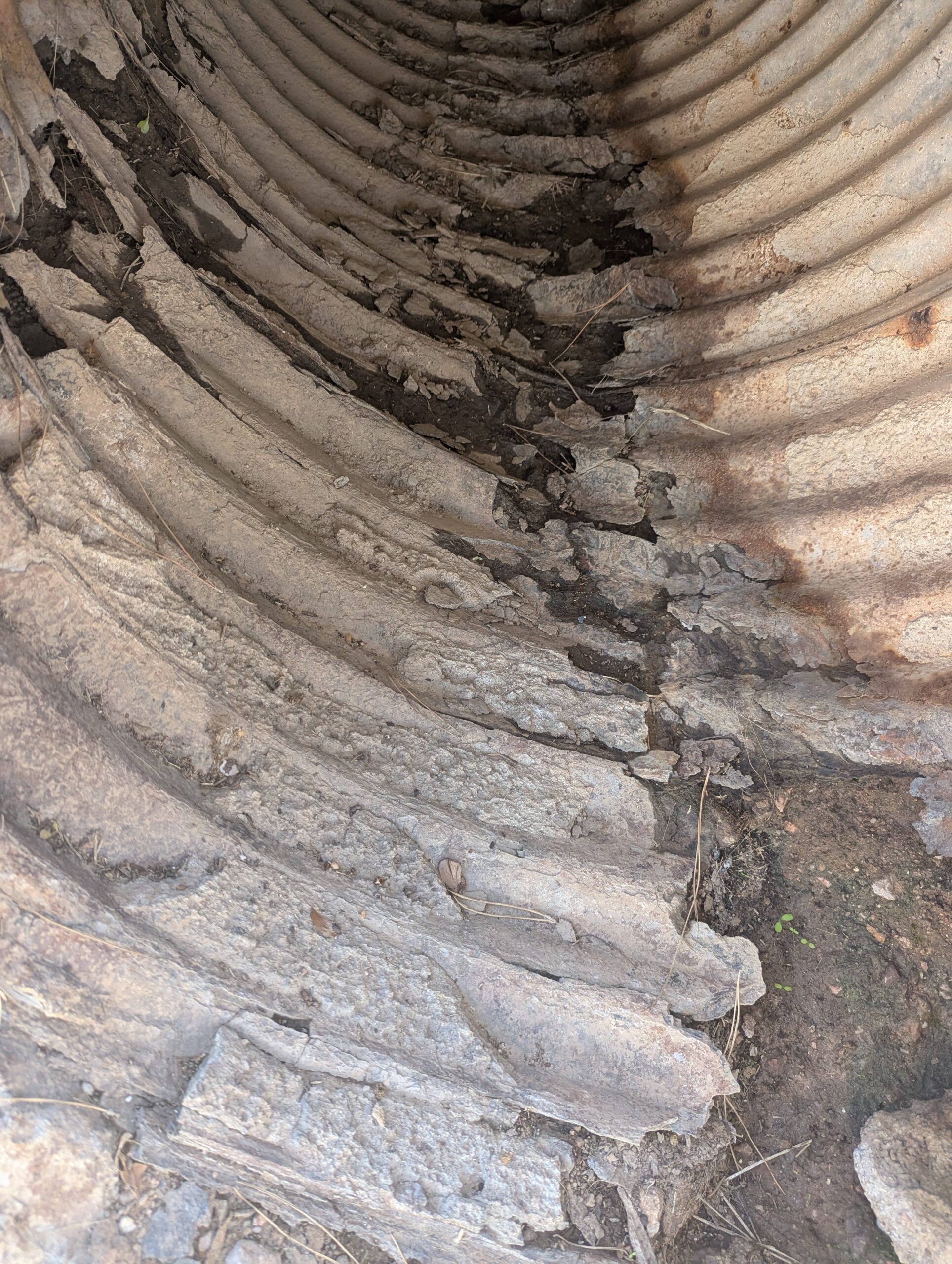
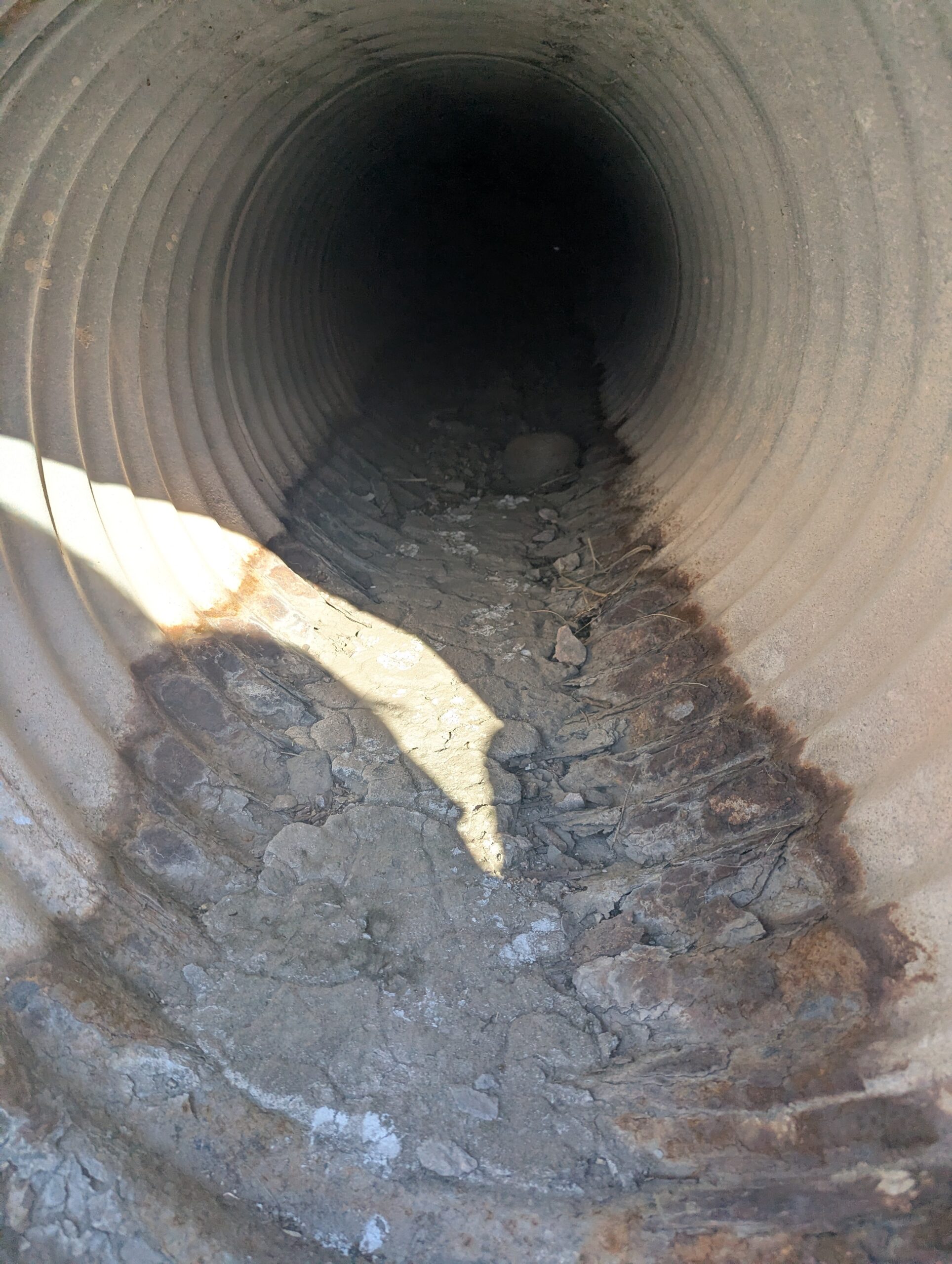
Click an image to enlarge.
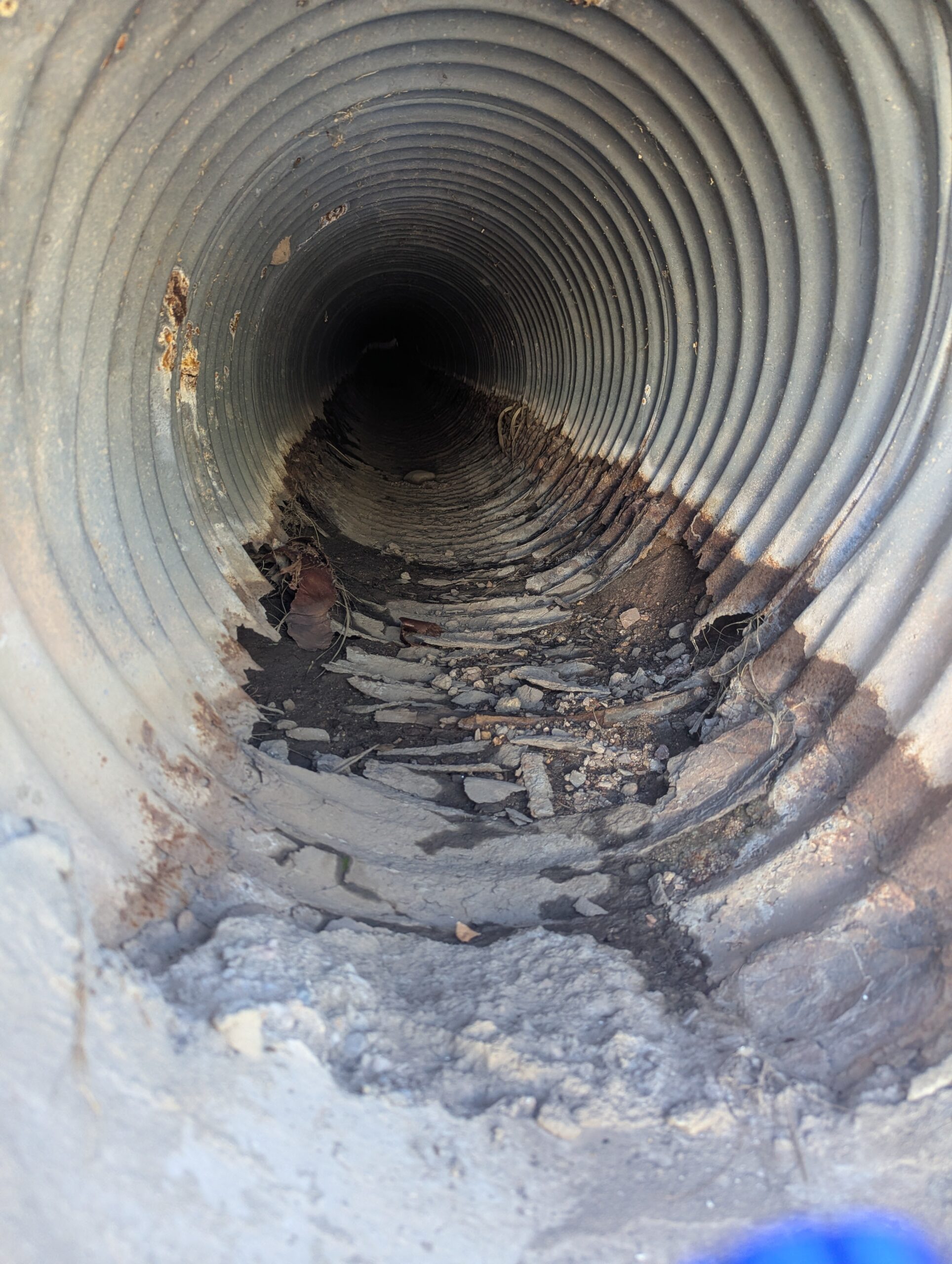
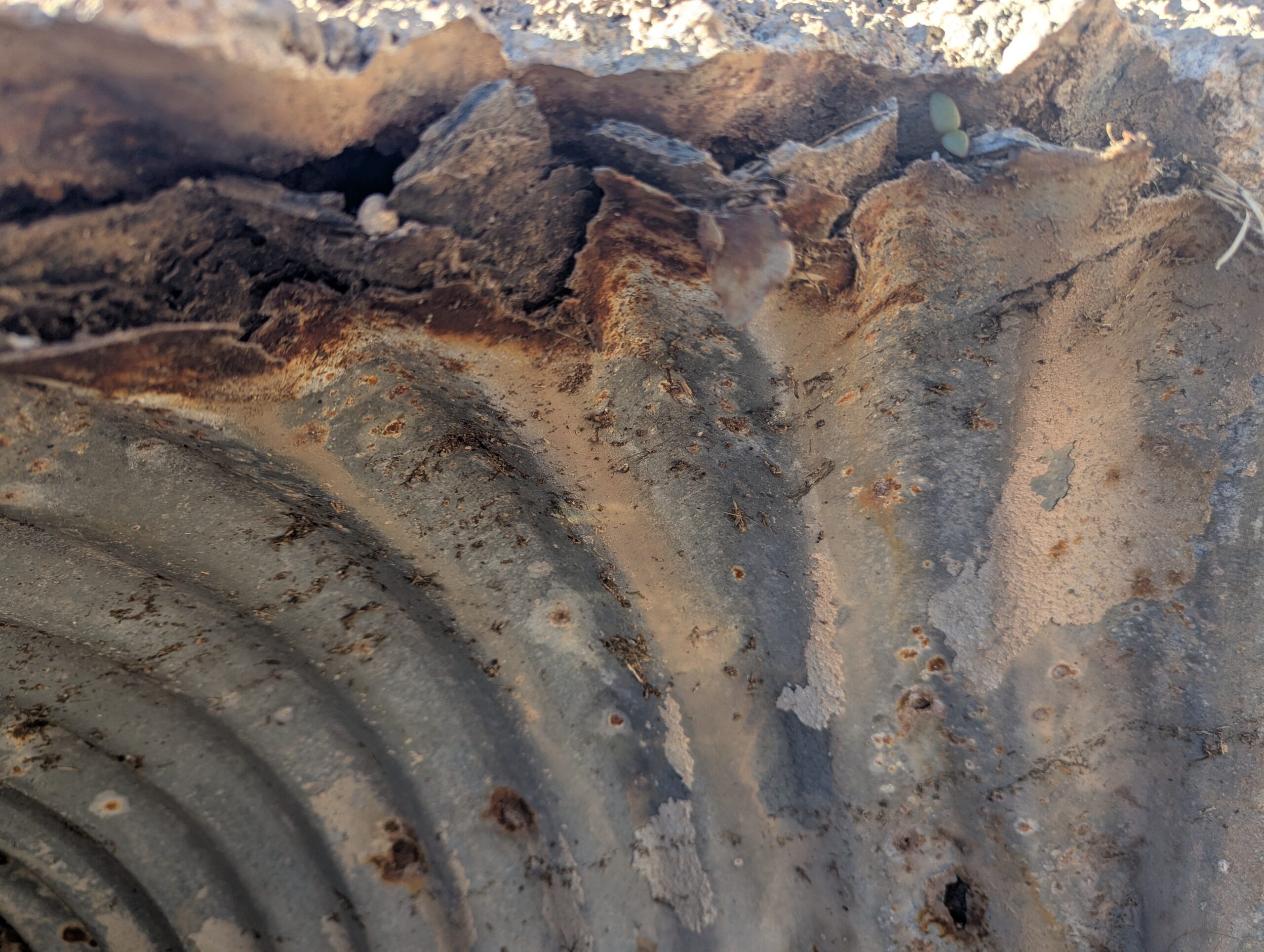
The culverts beneath this section of roadway have reached the end of their useful life and are severely deteriorated. Rusted-through sections are exposing soil and weakening the street above, while trapped water is accelerating corrosion and increasing the risk of flooding or sinkholes. Replacing these culverts now is critical to prevent roadway failure, protect public safety, and avoid costly emergency repairs.
Costs: Culvert Repairs $340,000.00
Lake Liner and Concrete – Hole #8
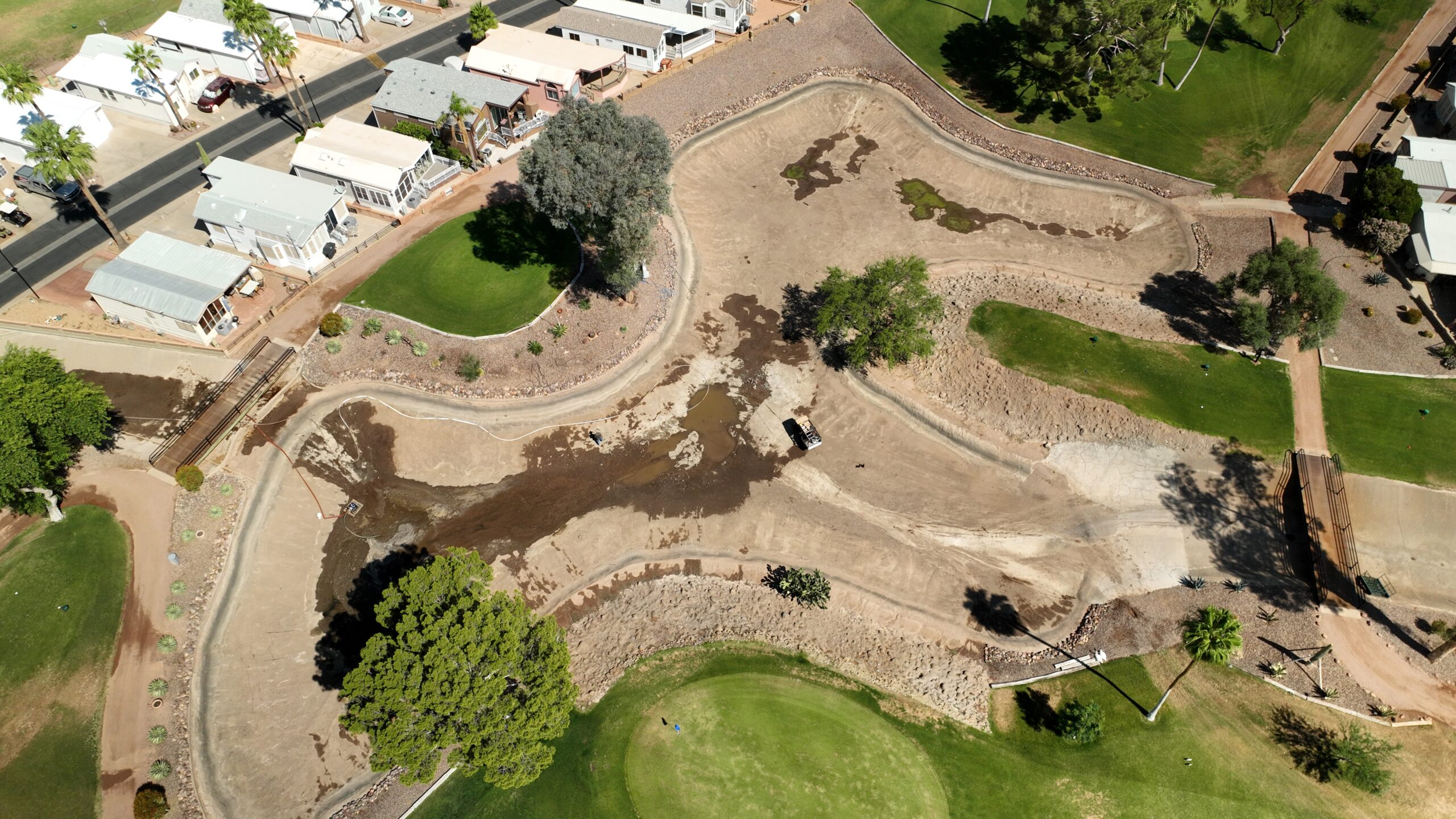
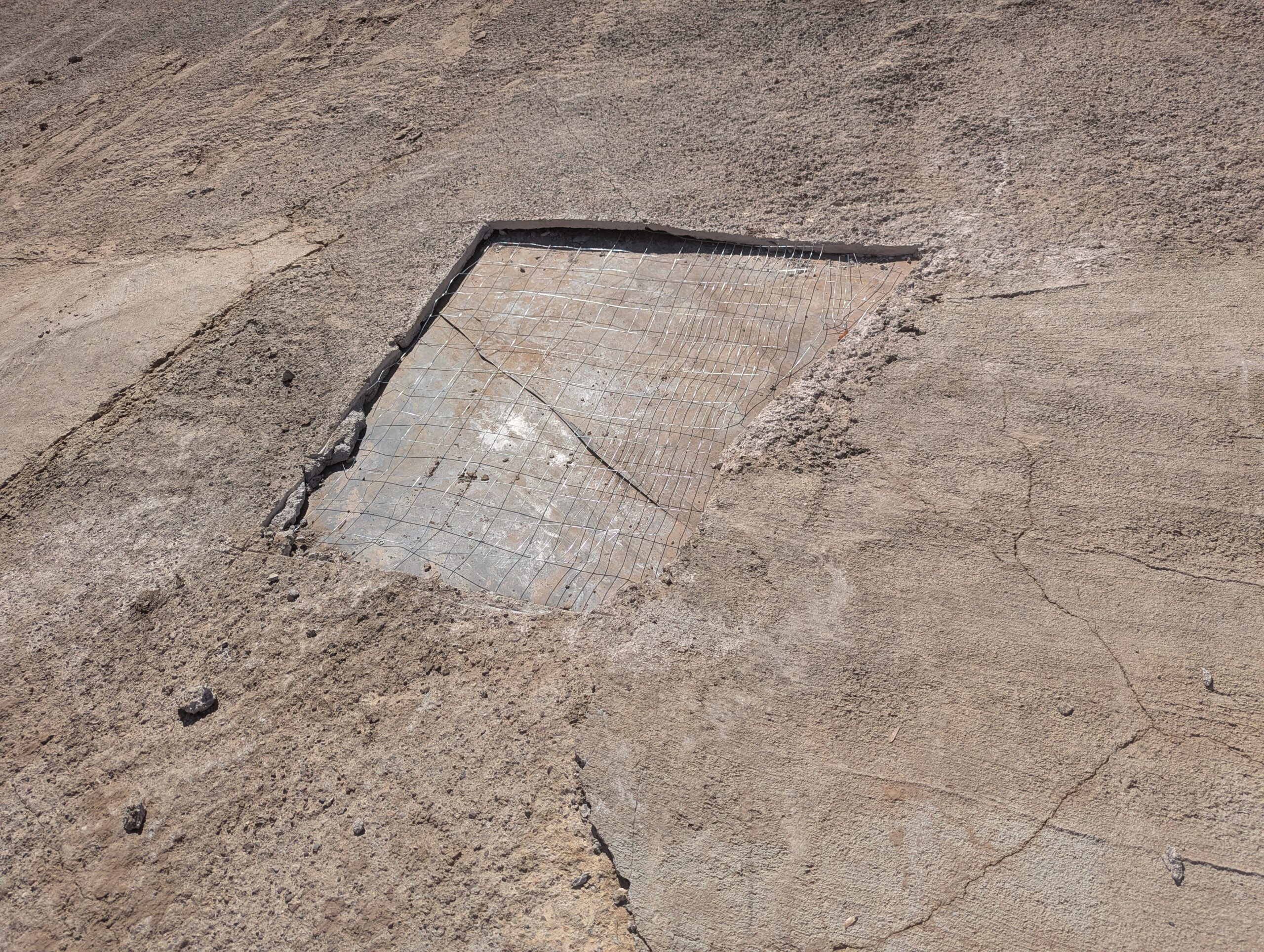
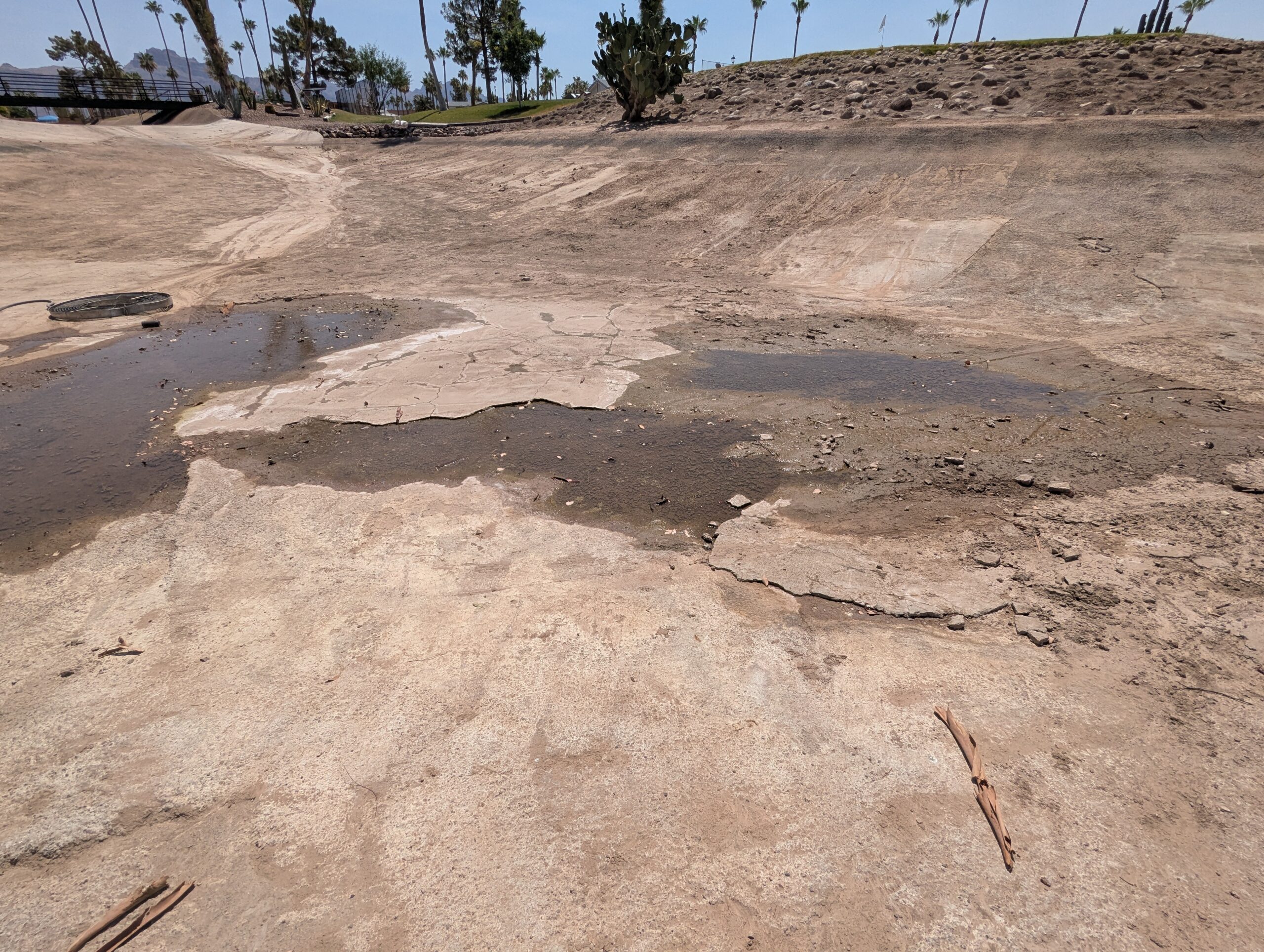
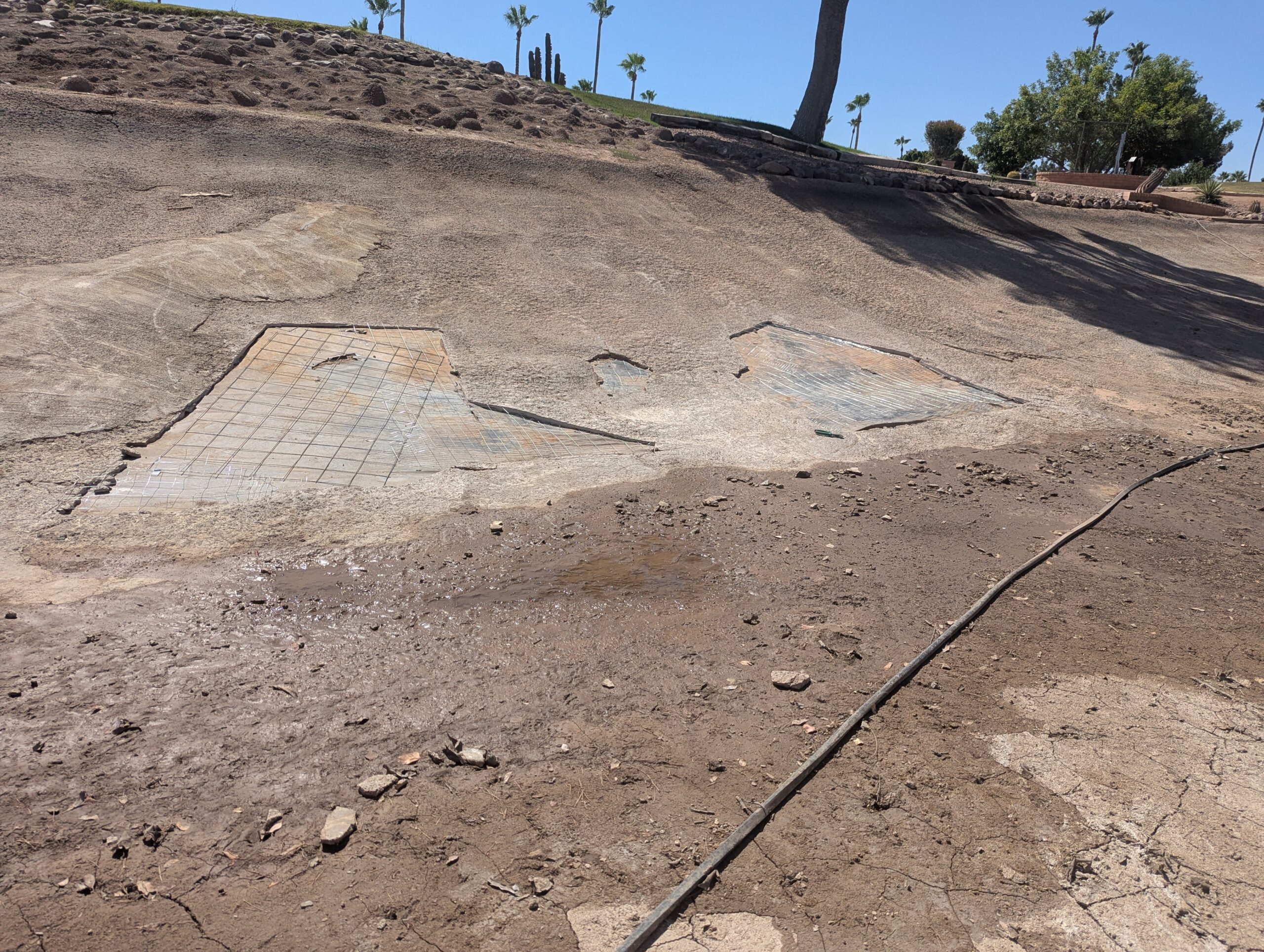
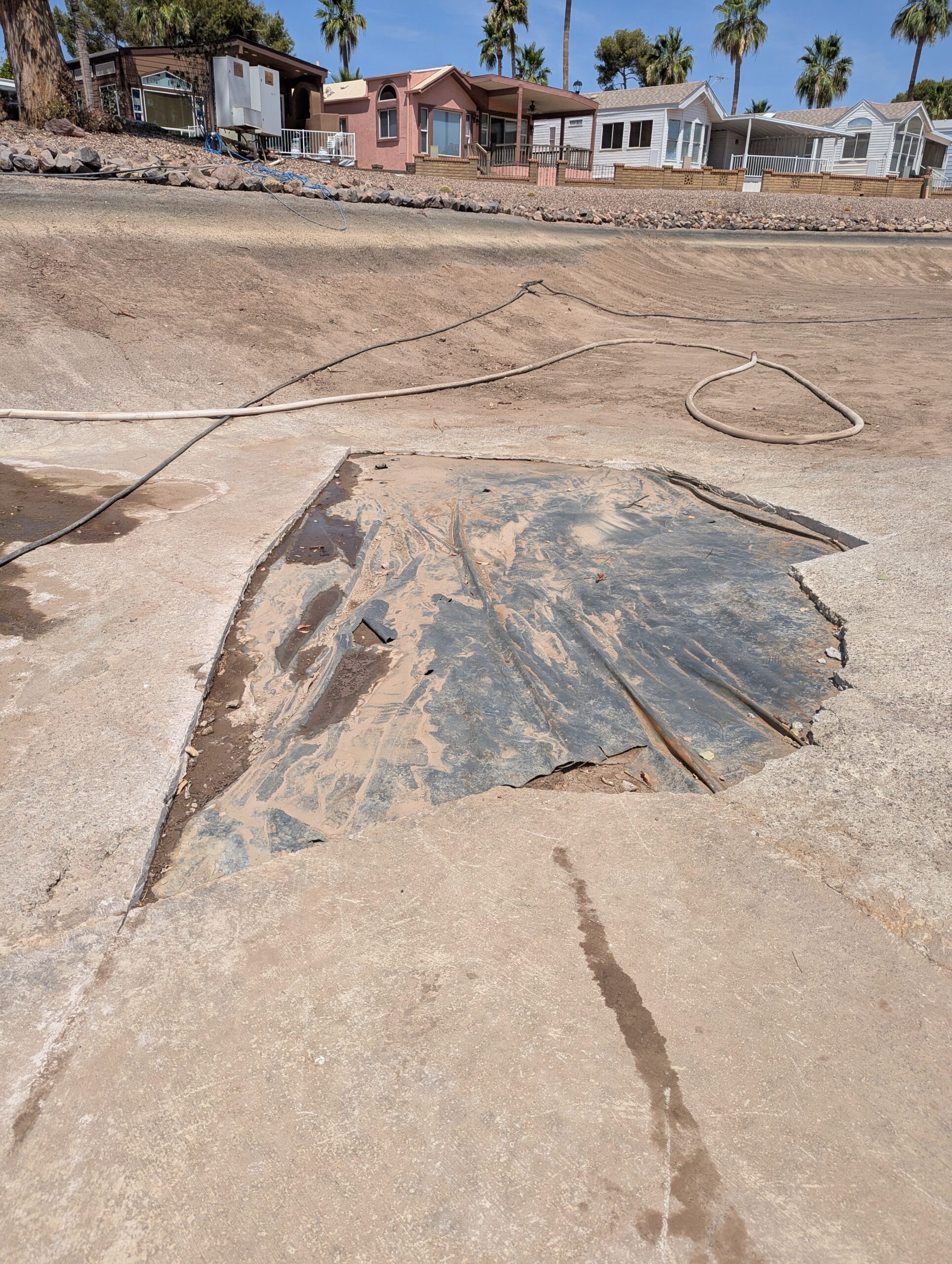
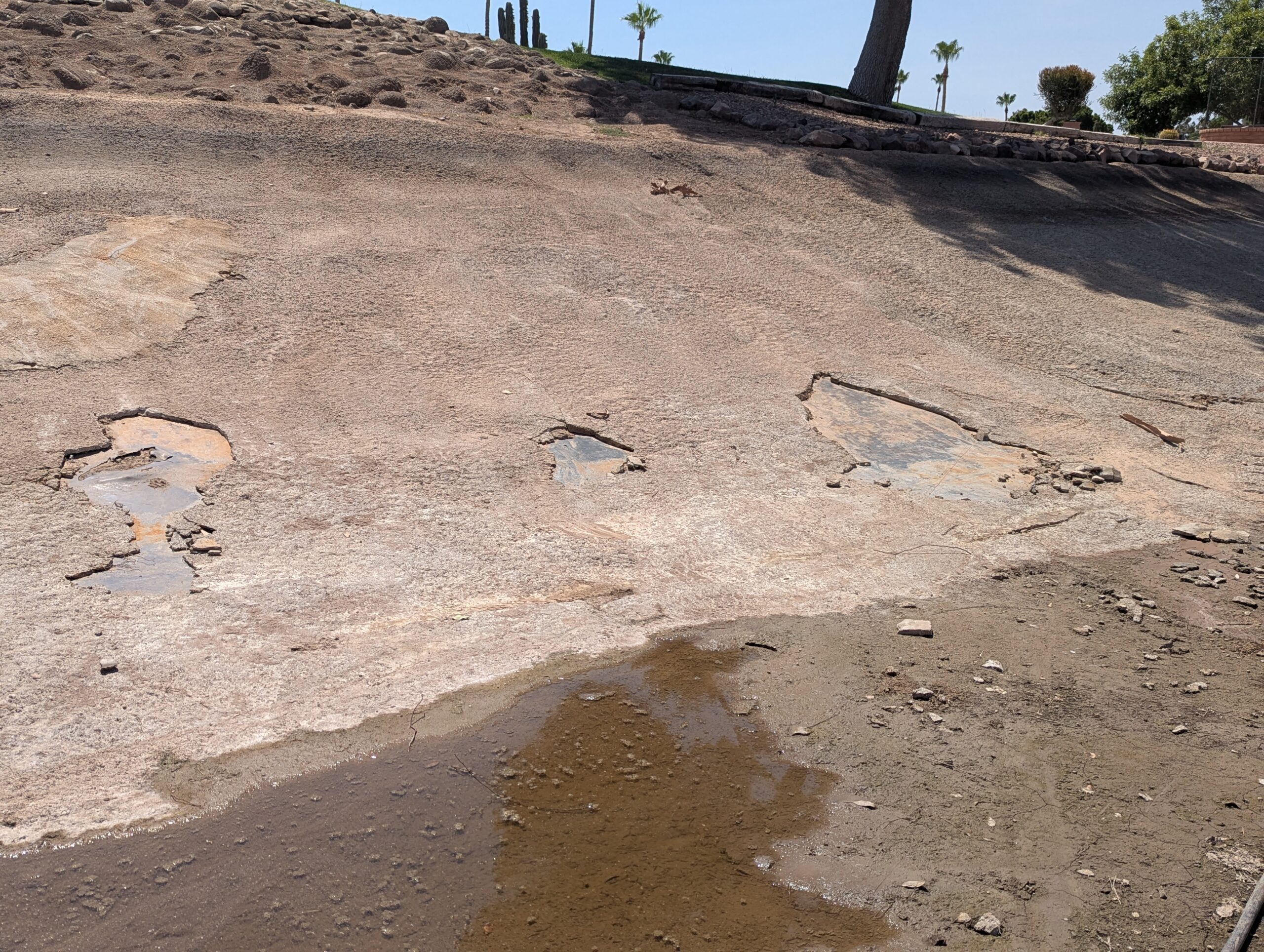
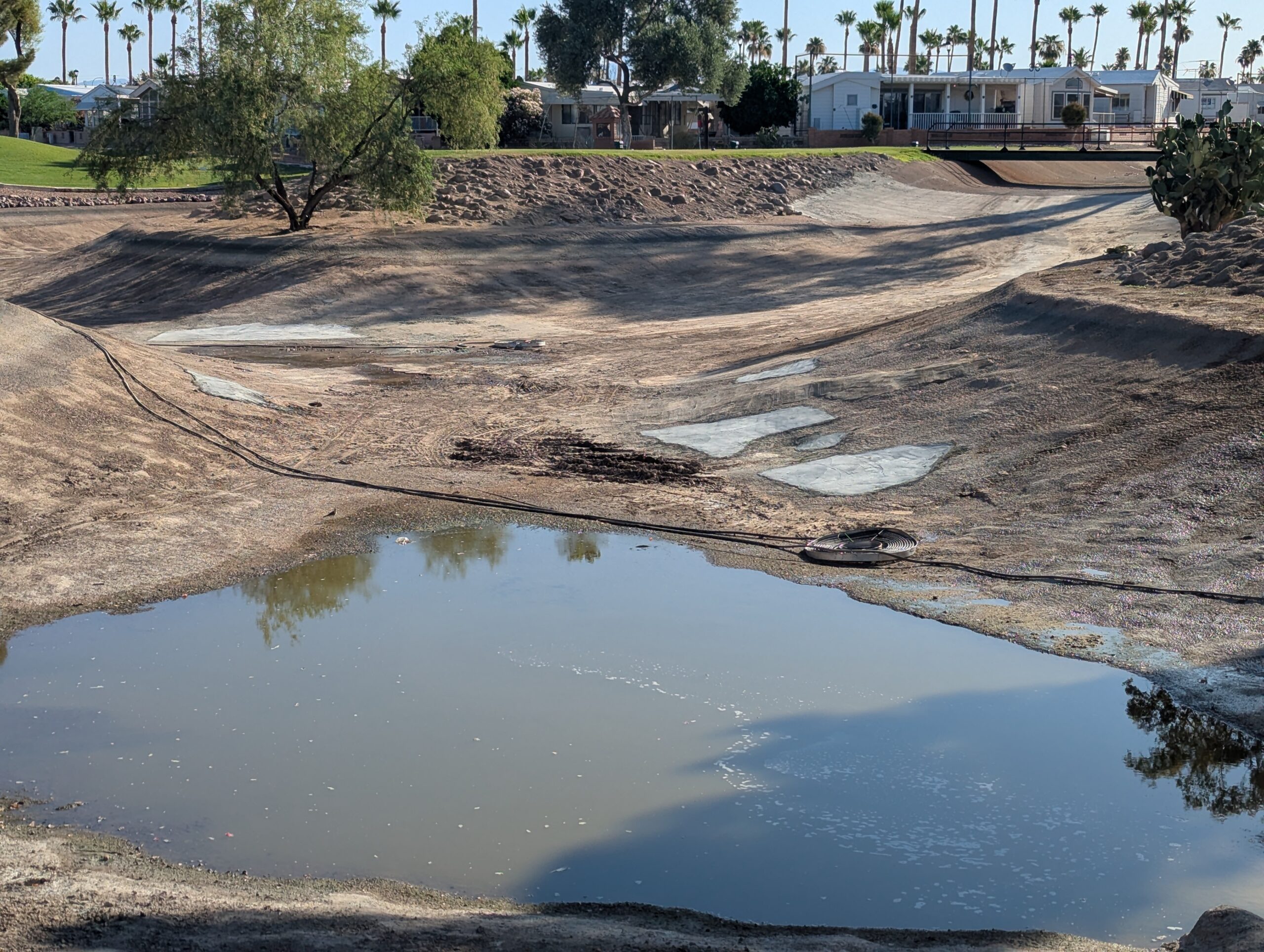
Click an image to enlarge.
The lake has both a liner and a concrete cap, which are repeatedly found cracked and torn during the required 3–5 year sediment cleanouts. Past patching is no longer effective, largely due to inadequate original concrete thickness, which has allowed ongoing failure and liner exposure.
This lake is part of the community’s drainage system and is directly connected to the canal that manages water flow through the north end of the resort, making its condition critical to overall drainage performance.
Costs: #8 Lake Liner/Asphalt/Concrete $1,200,000.00
Boom Lift
Purchasing a boom lift is primarily a safety investment for the community. Relying on ladders for high-reach work creates significant risk of falls, injuries, and liability. A boom lift allows staff to safely perform elevated tasks such as exterior painting, light maintenance, minor tree trimming, rooftop access, and equipment repairs. It greatly reduces the chance of accidents while also eliminating repeated rental costs and improving work efficiency.
Costs: Boom Lift $30,000.00
Salt Cell System - Phase II Pool & Spa
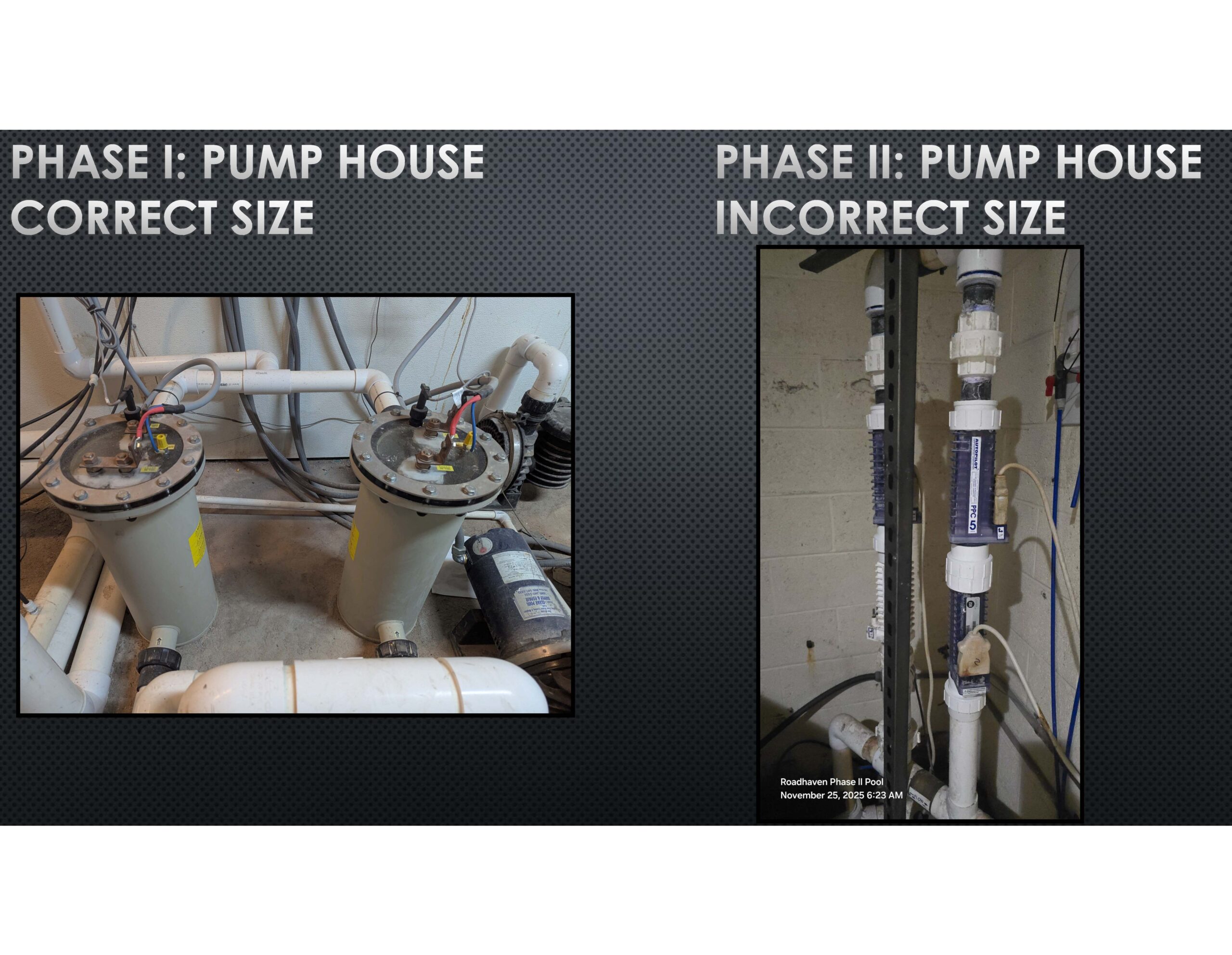
Click an image to enlarge.
Current salt cells are undersized and stacked to meet demand, stressing equipment and reducing performance. A commercial-grade system is required for proper sanitation and reliability.
Costs: Salt Cell System Phase II $22,360.00
Sand Filters – Phase I & II Pools & Spa
Five of the six filters for Phase I & Phase II pools and spas have exceeded their useful life, reducing filtration effectiveness and water quality while increasing the risk of equipment failure. Replacing them will improve system performance, enhance water quality, and improve overall skimmer effectiveness.
Costs: Phase I and Phase II Sand Filters $18,045.00
Phase II Pool/Spa Resurface & Deck
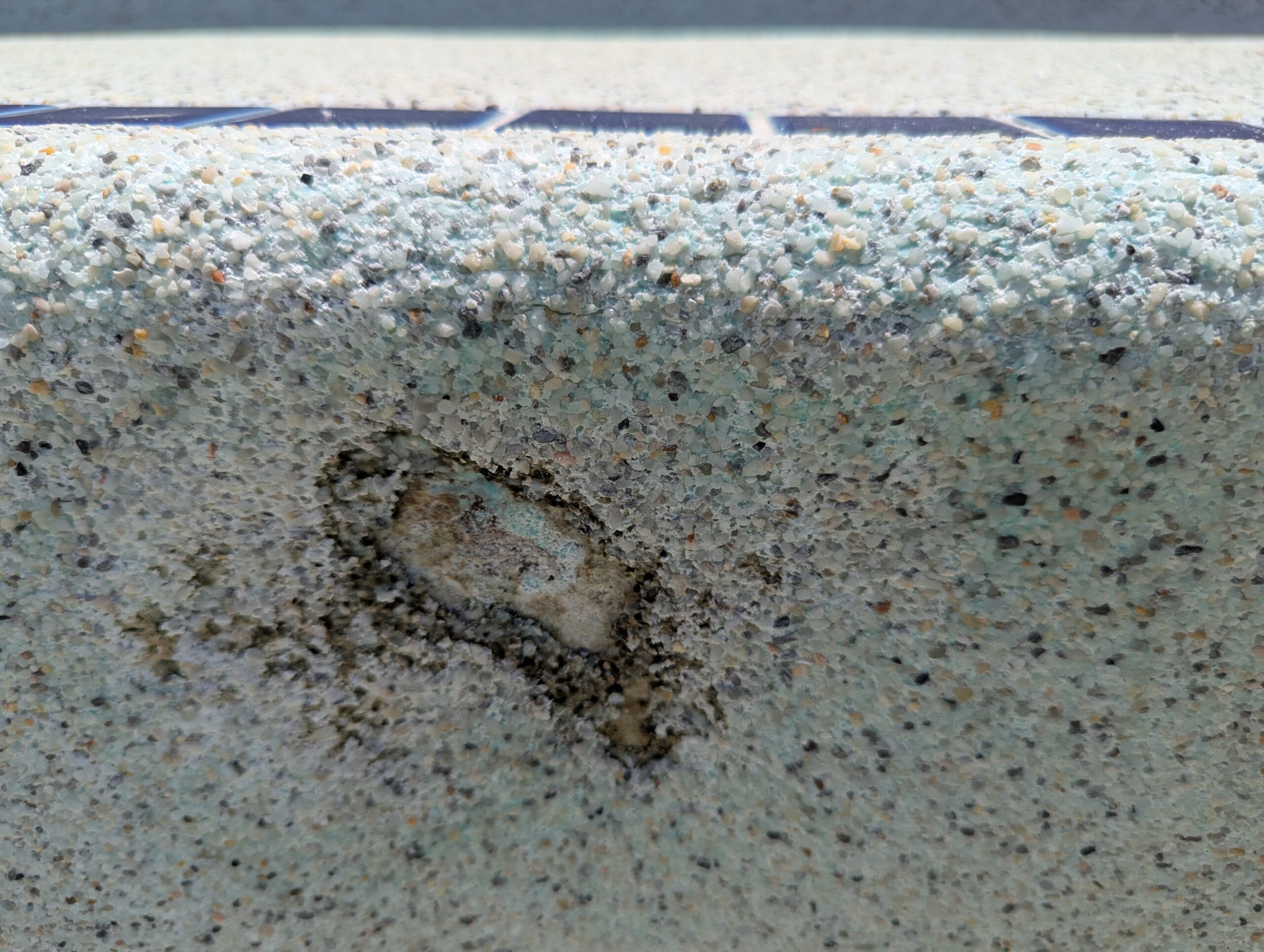
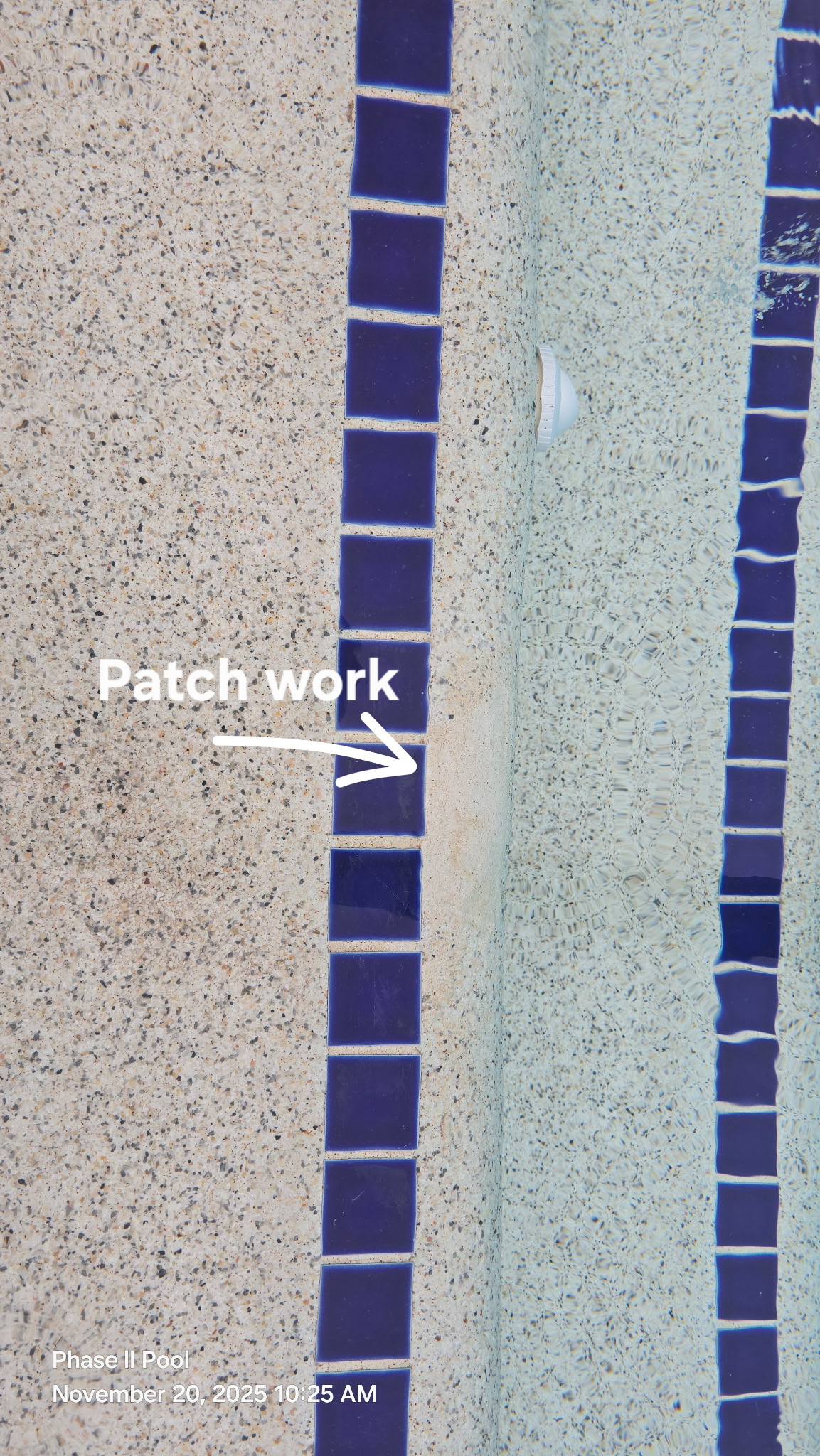
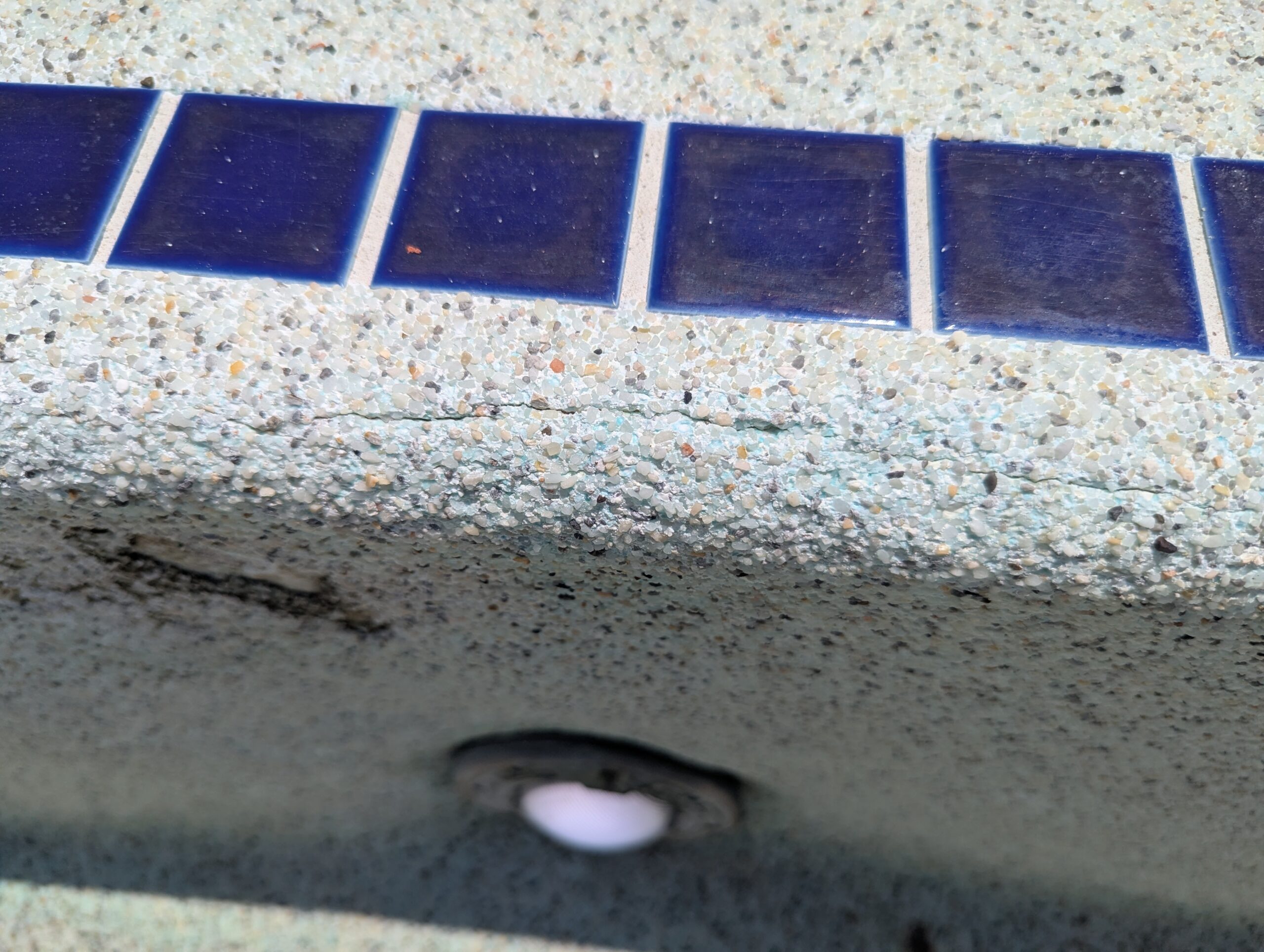
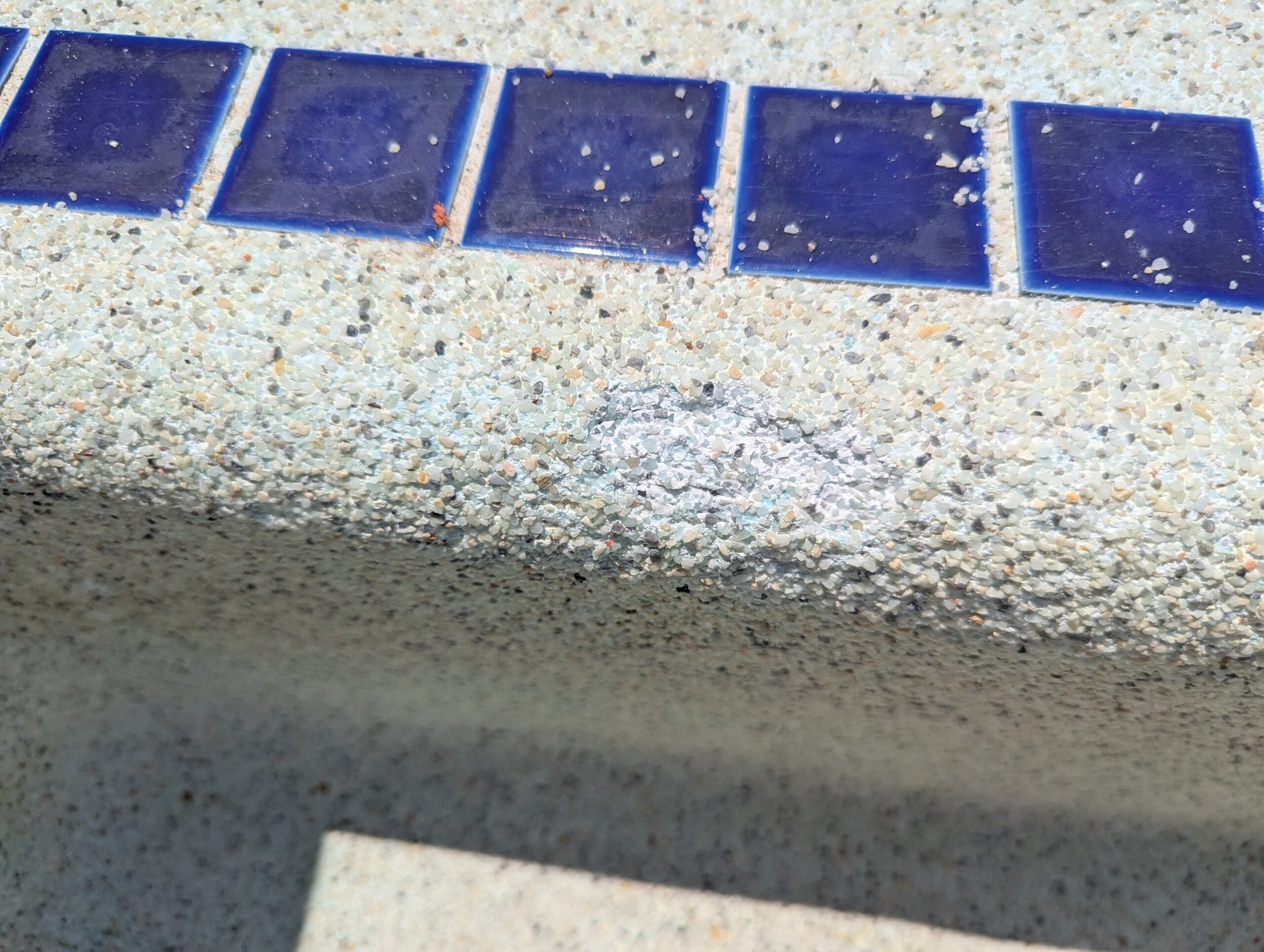

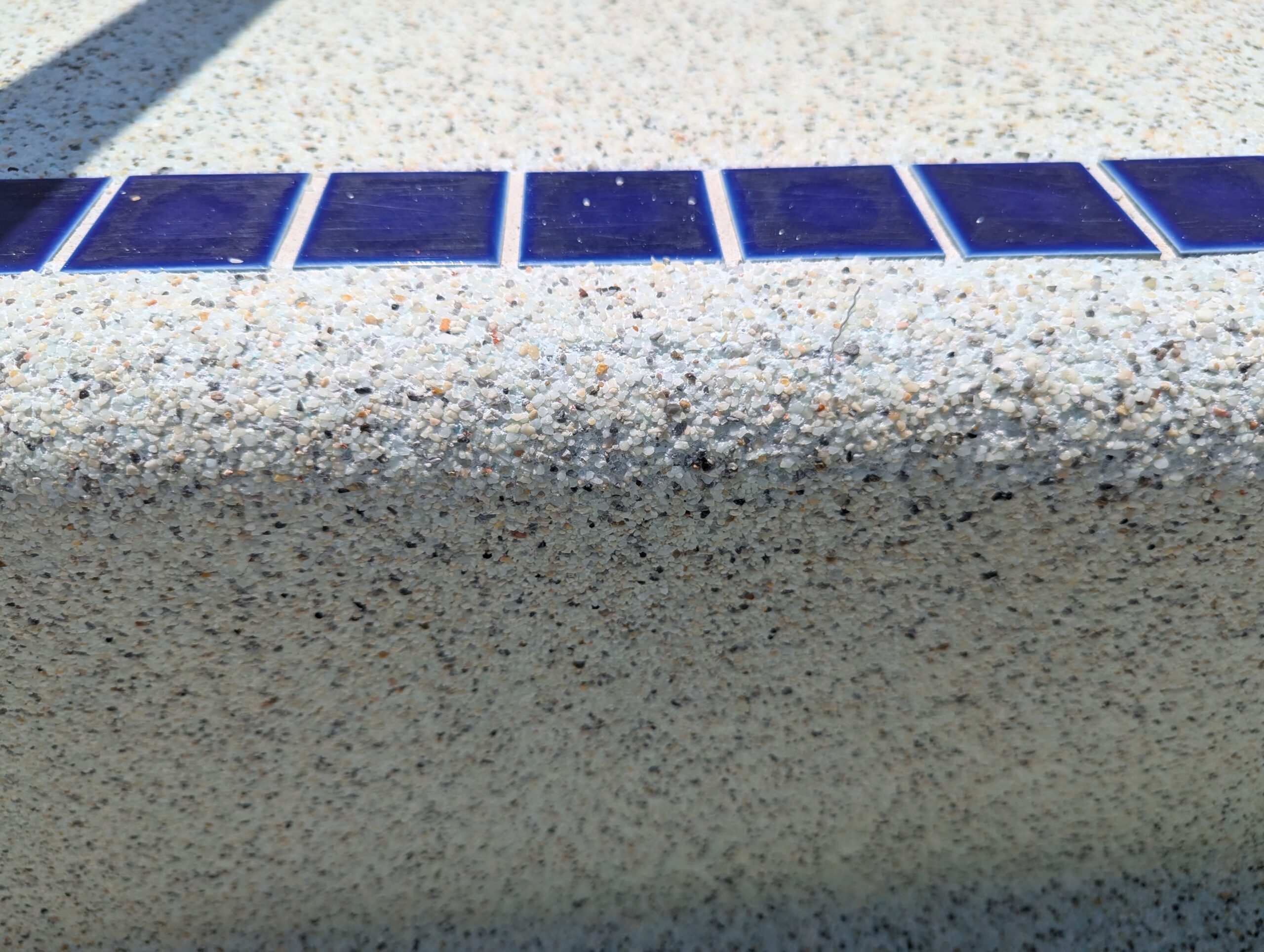
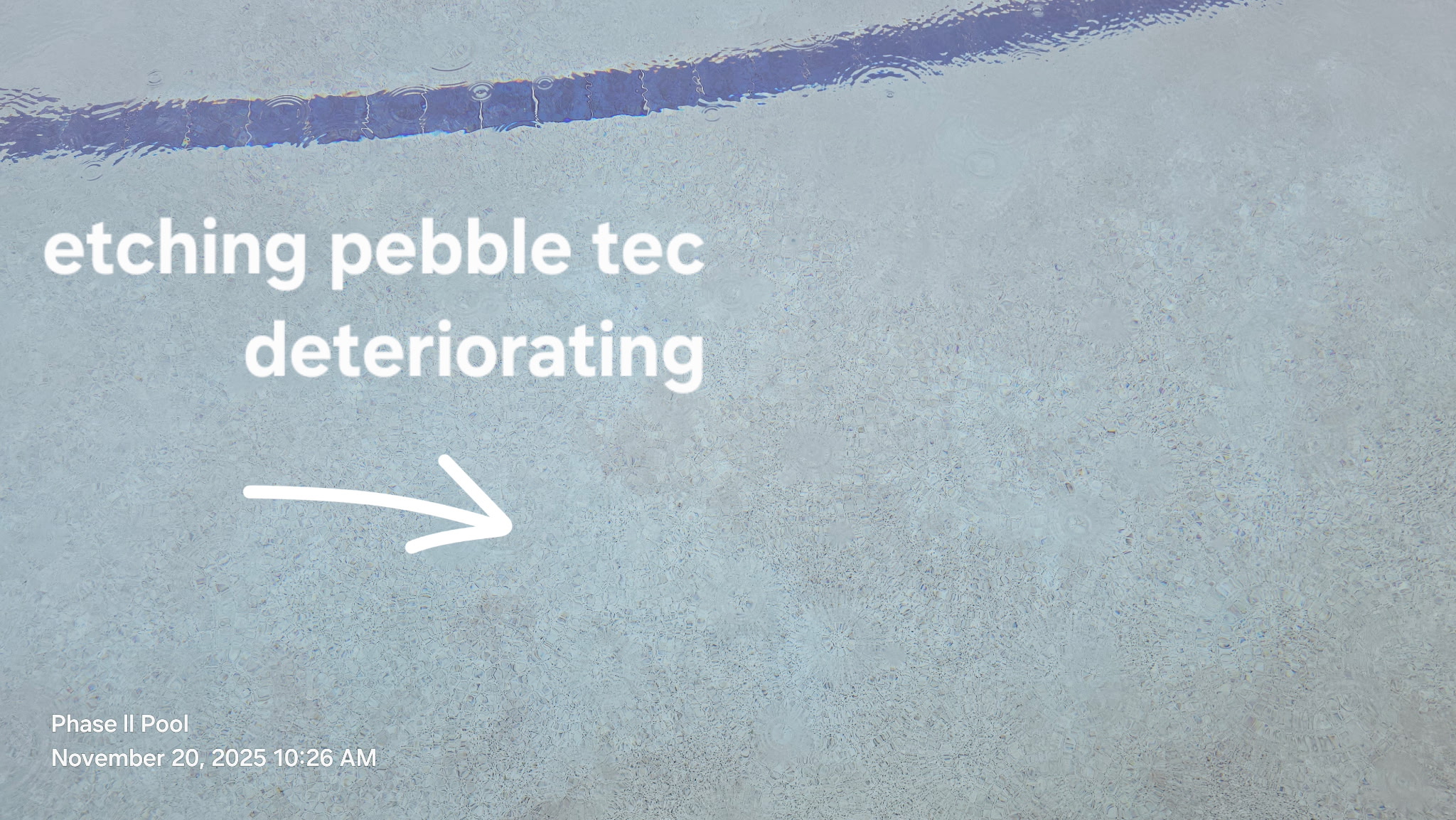
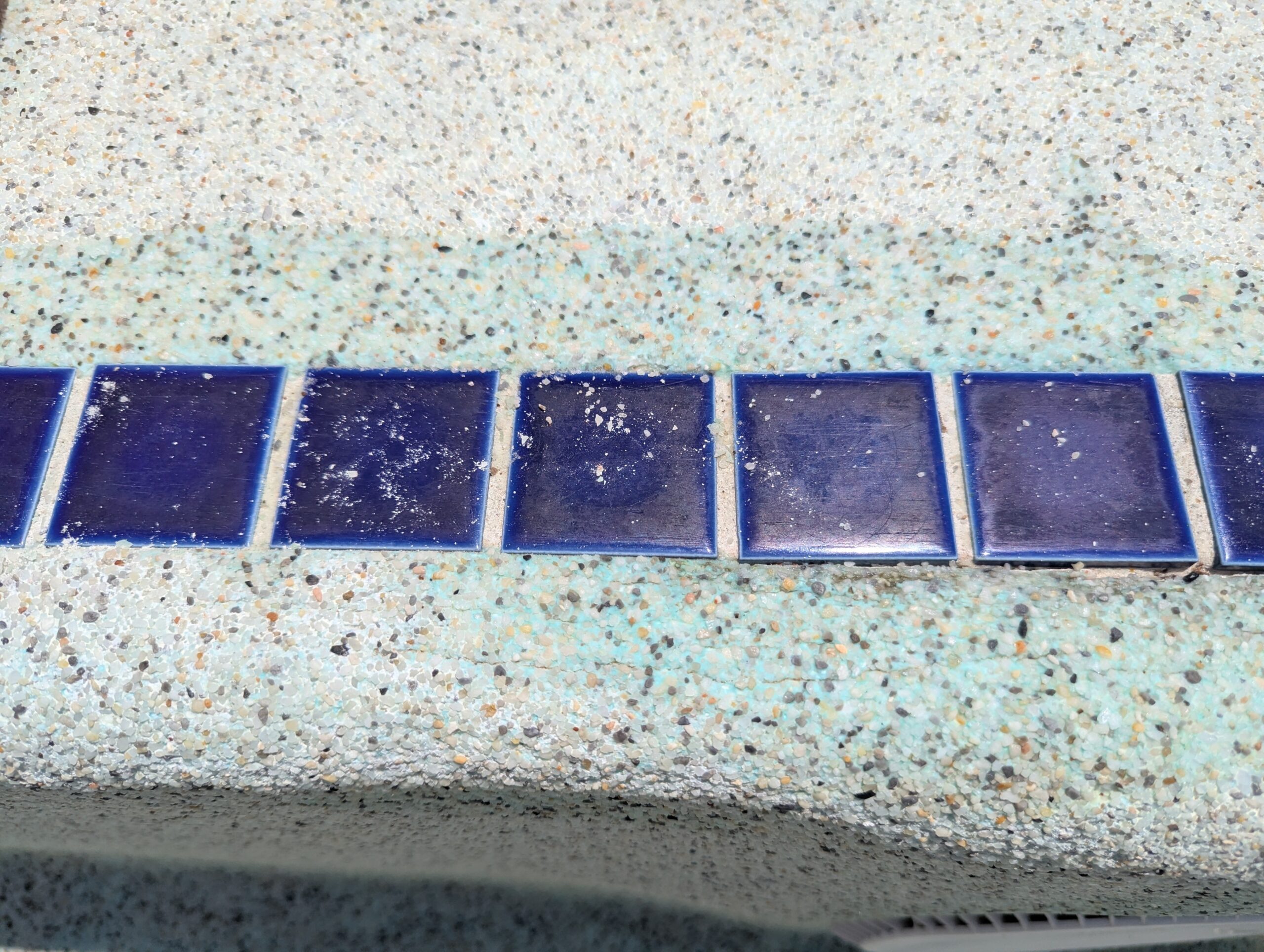
Click an image to enlarge.
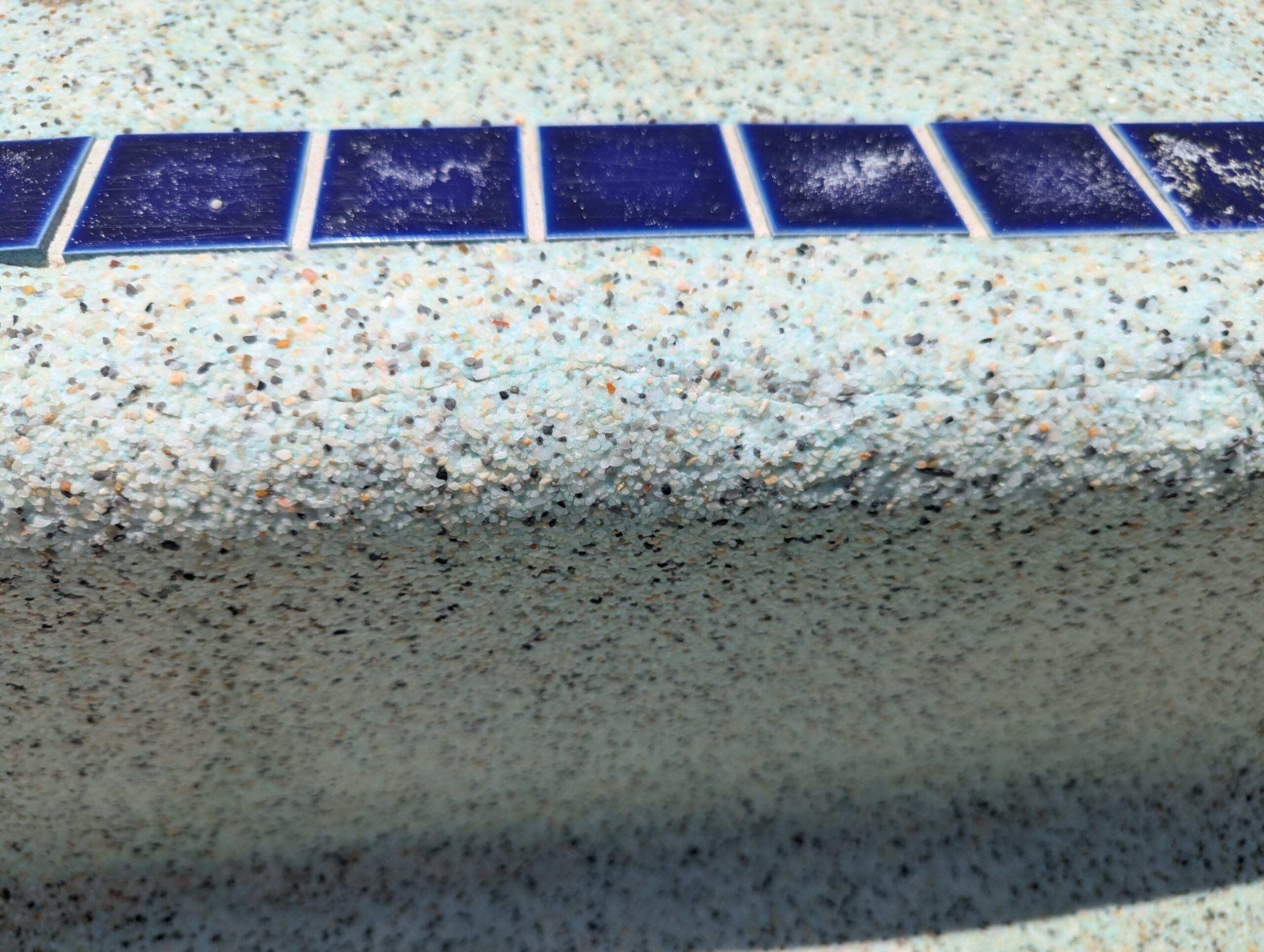
Pool and spa surfaces are failing, with cracks and material loss despite repeated patching. The deck’s rubberized surface is trapping moisture in areas, causing bubbling, staining, and ongoing deterioration. Full resurfacing and deck rehabilitation are needed.
Costs:
- Phase II Pool/Spa Resurface $63,800.00
- Phase II Deck $45,000.00
Reseal Streets
Streets should be resealed every 5–7 years to prevent cracking, water intrusion, and major structural failures, protecting long-term roadway investment.
Costs: Reseal Streets $185,968.00
Drinking (Water) Fountains
Several fountains are at the end of their useful life, with increased failures, leaks, and electrical risks. Replacement improves safety and reliability.
Costs: Water Fountain Replacements $9,000.00
HVAC & Condenser Replacement
Multiple heat pumps, gas packs, mini-splits, and the Rec Hall ice machine condenser are past useful life. These aging systems are less efficient and prone to failure. Aging systems are less efficient and increasingly prone to sudden failure; Proactive replacement helps control expenses and maintain reliability.
Costs:
- Heat Pumps, Gas Packs, Mini Splits $96,500.00
- Rec Hall Ice Machine and Condenser $8,000.00
Concrete - Canal & Common Areas
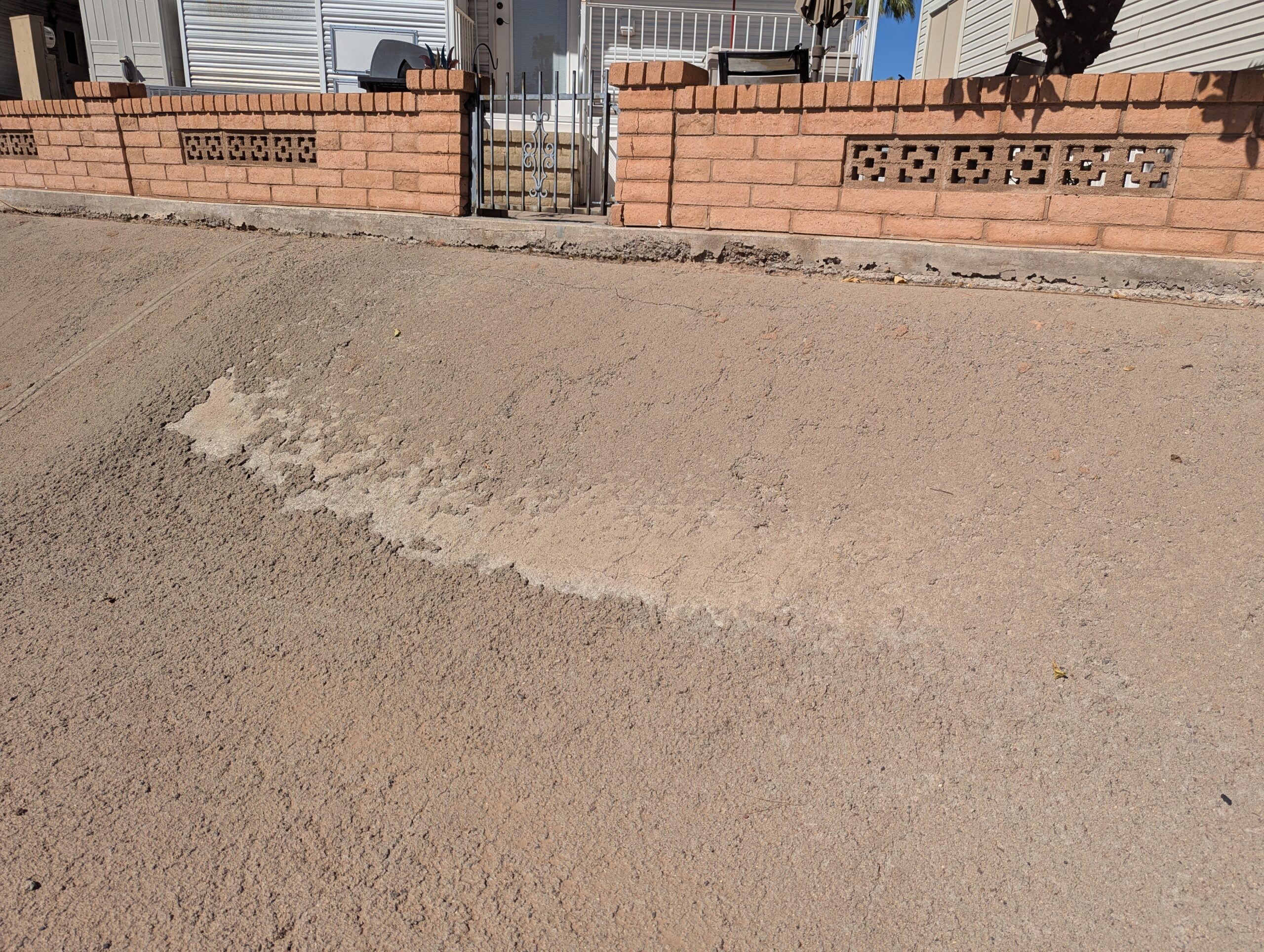
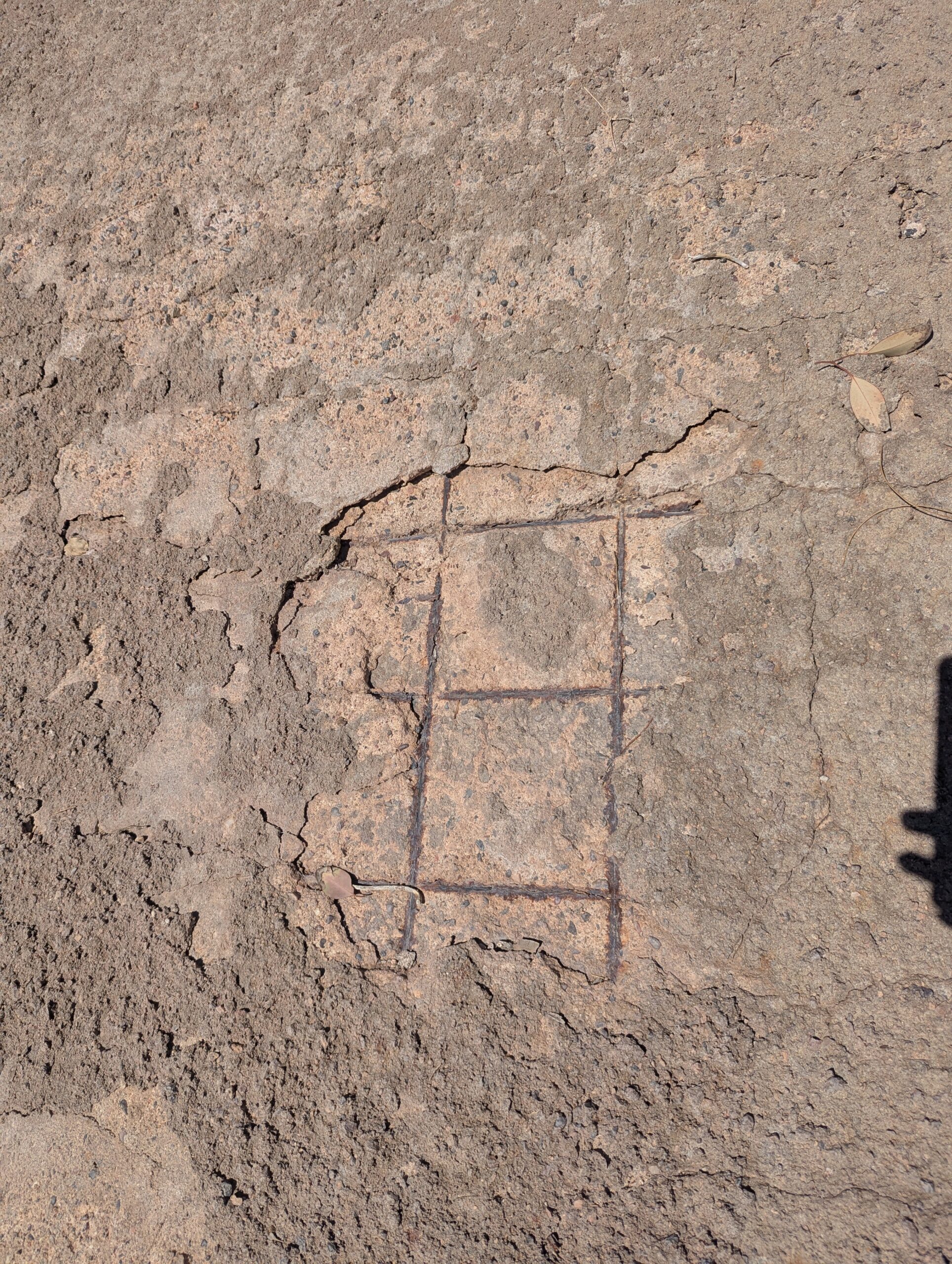
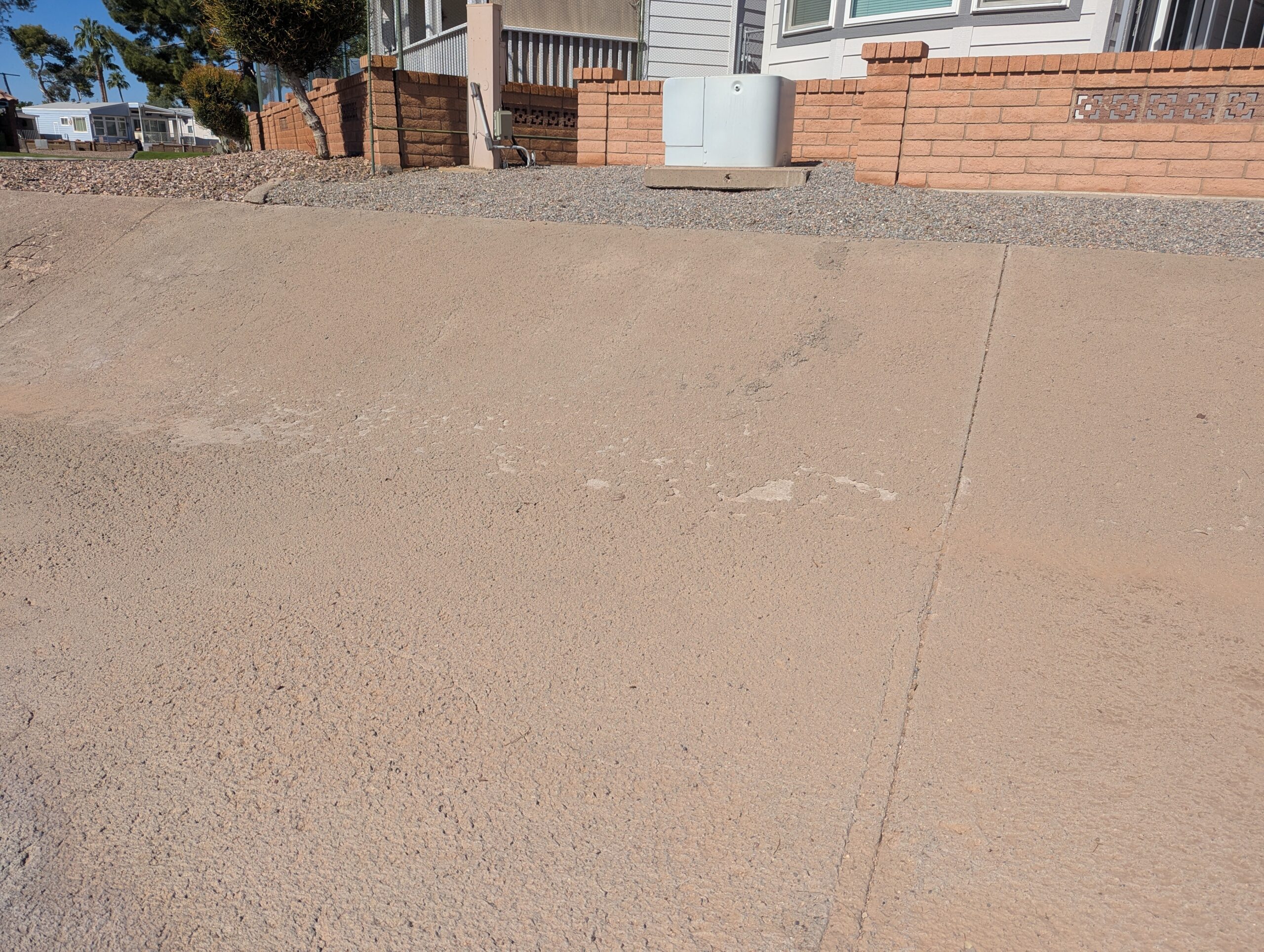
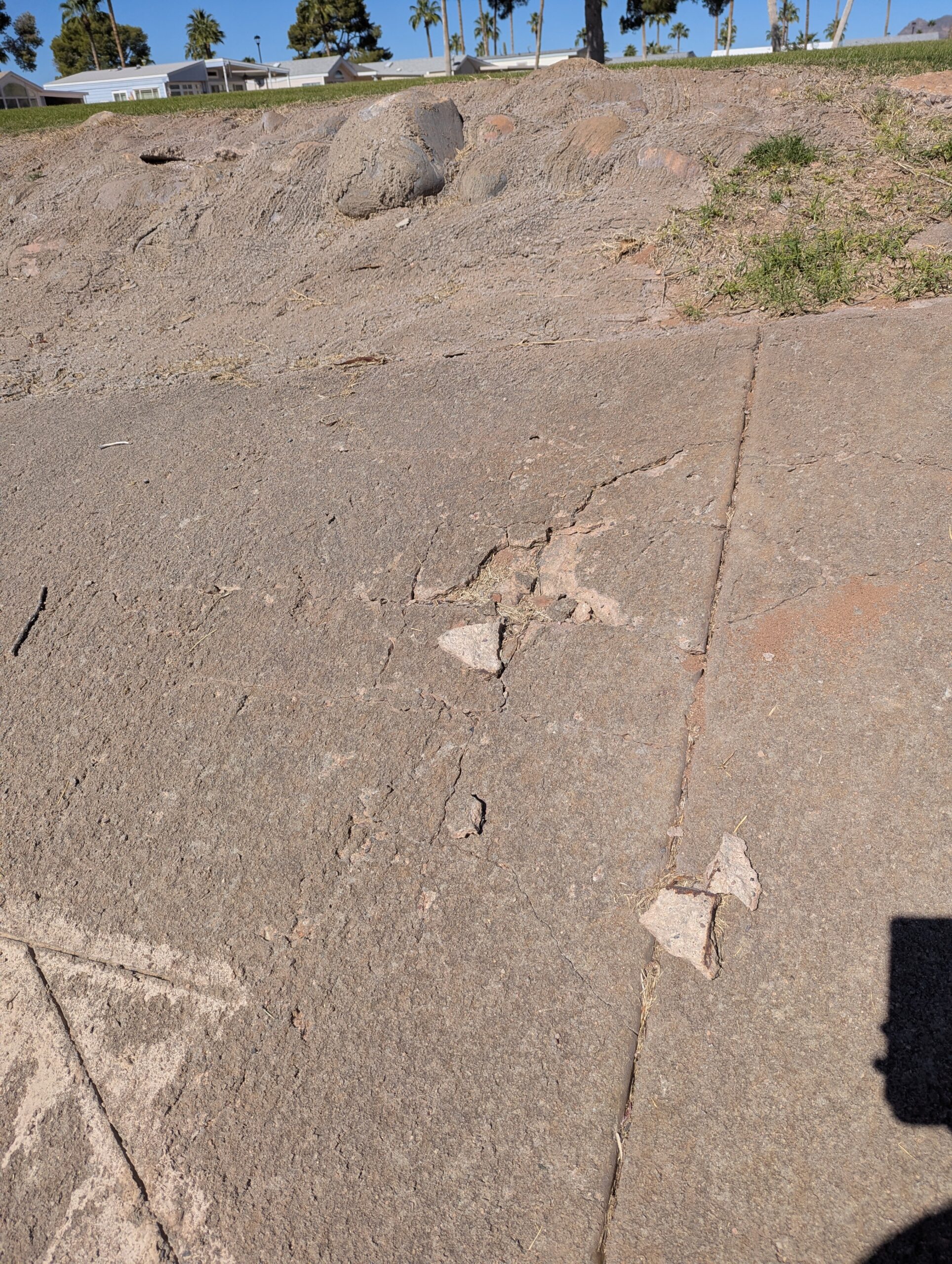
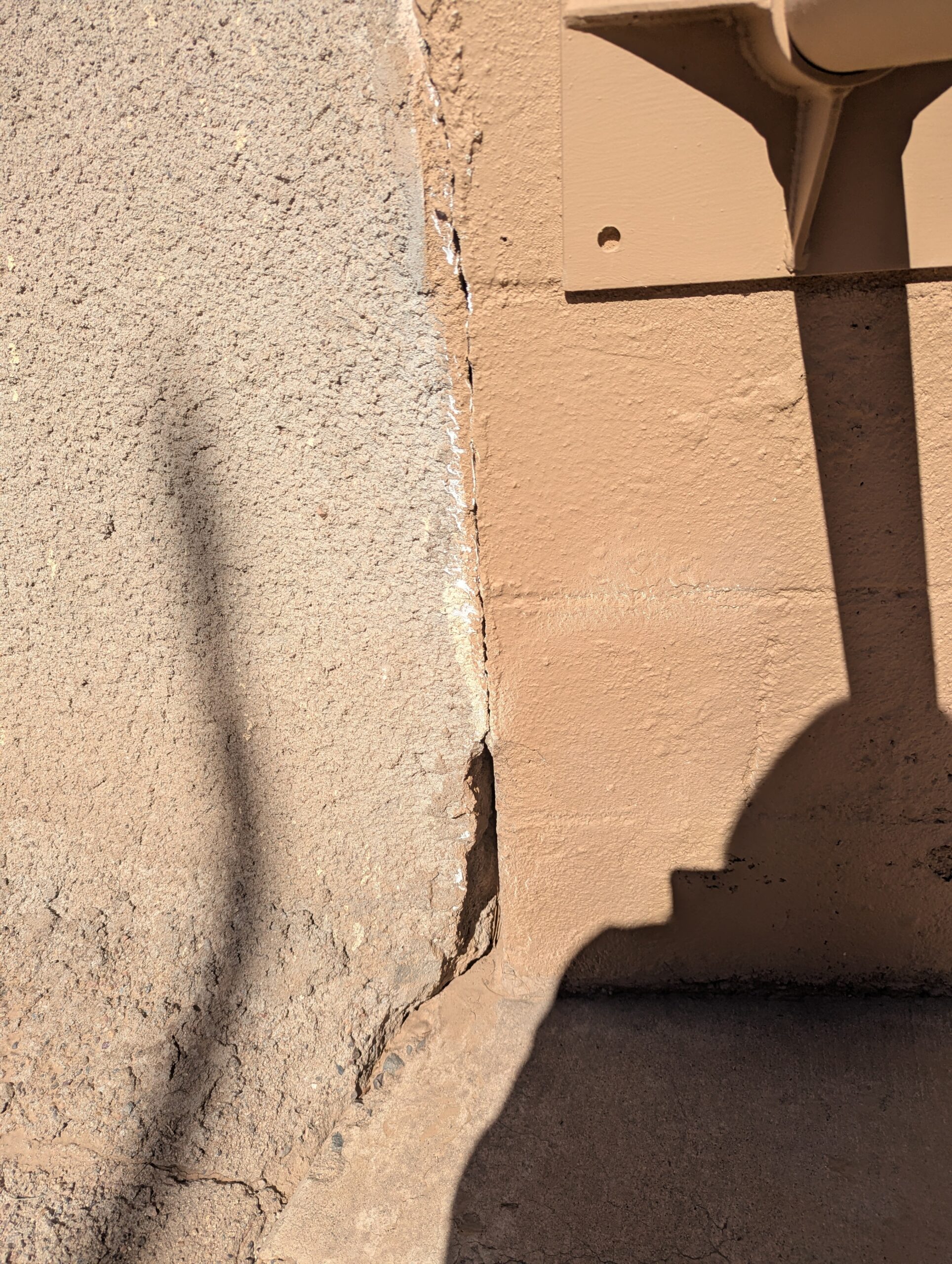
Click an image to enlarge.
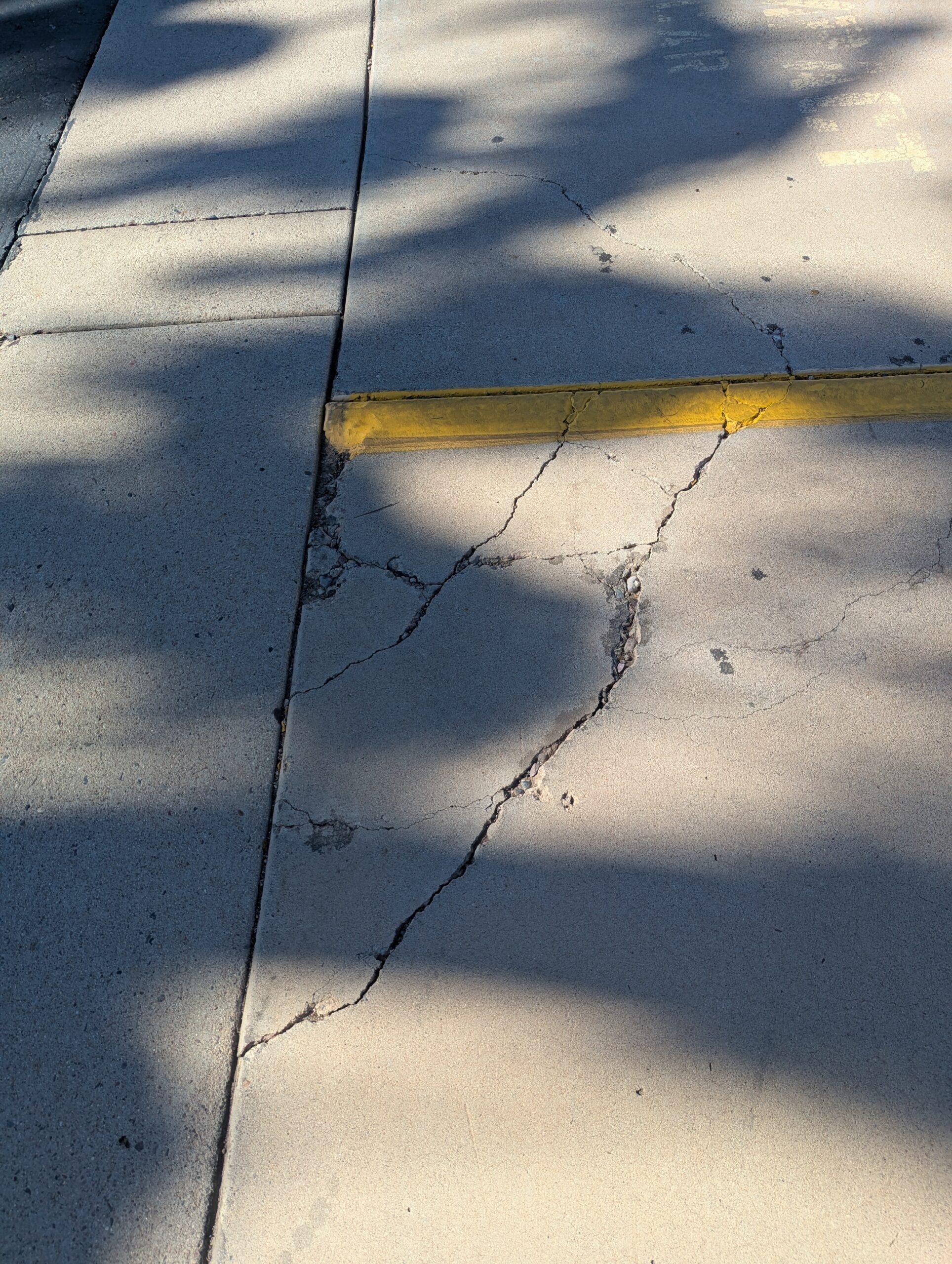
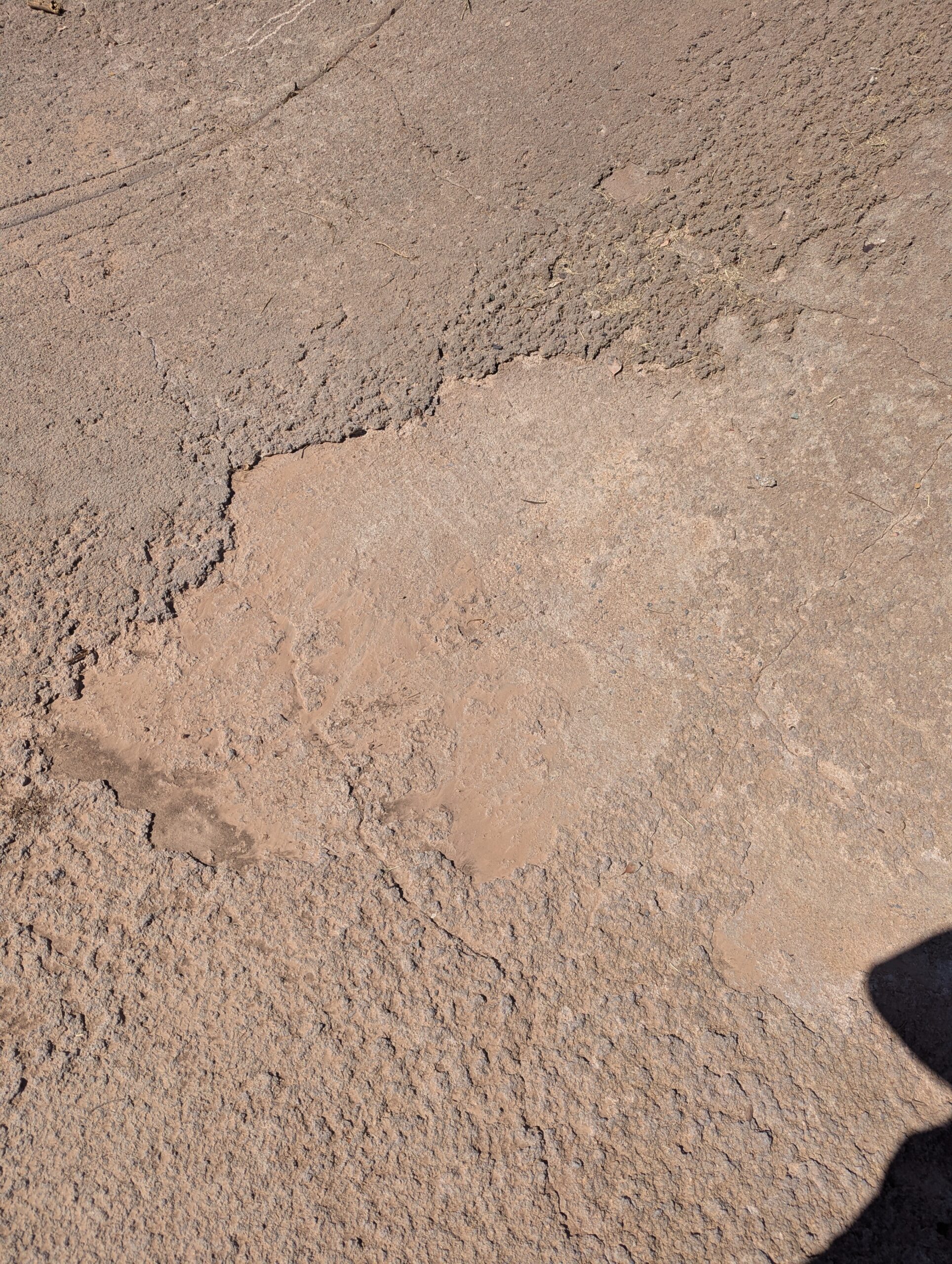
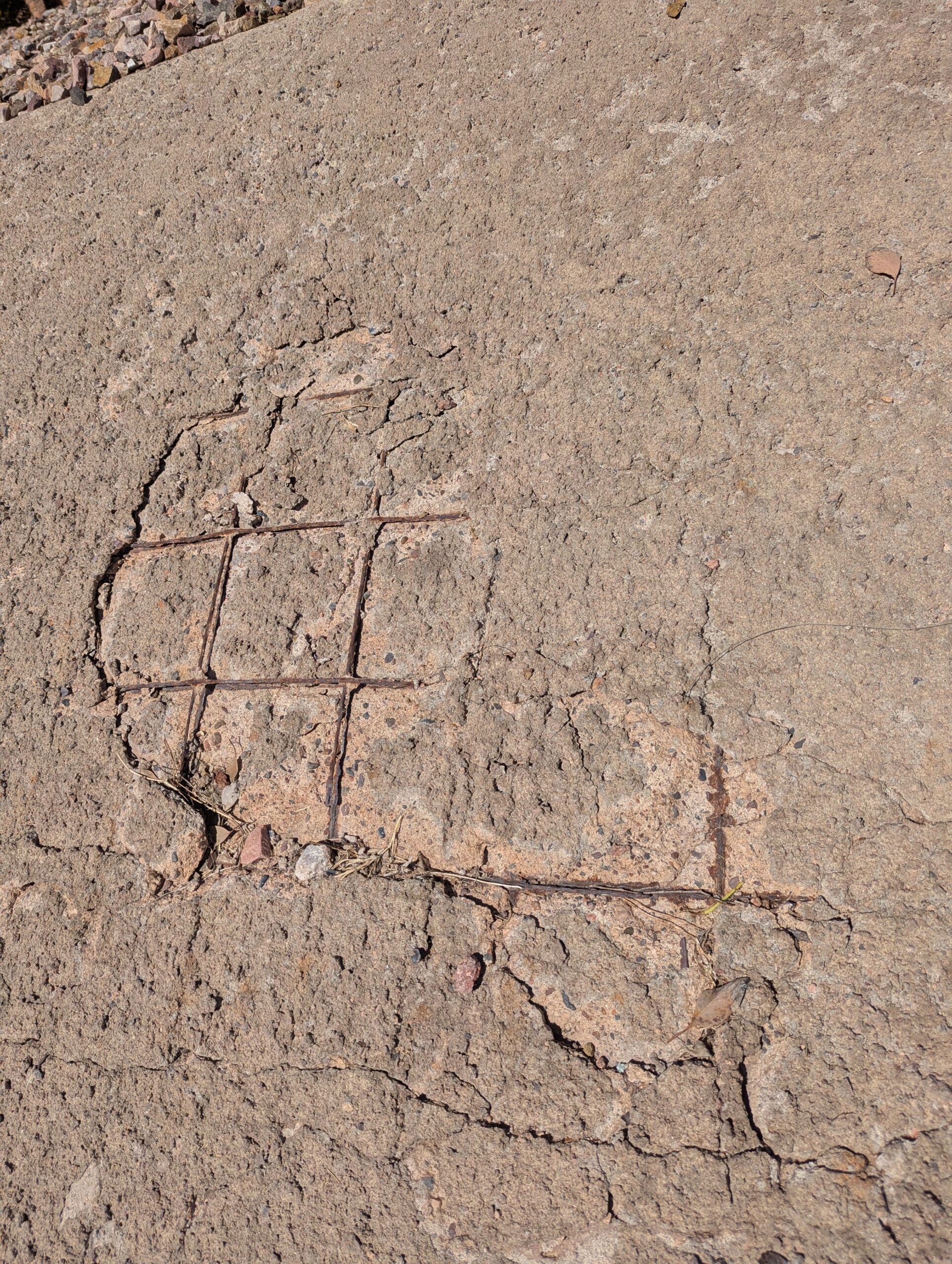
Cracked, settled common area concrete and exposed rebar in the canal create safety and structural risks, especially in drainage canals. Ongoing, prioritized repairs are required to manage risk and prevent larger failures.
Costs: Concrete Repairs – Common Areas/Canal $12,000.00
Phase I Aquatic Building Moisture Barrier
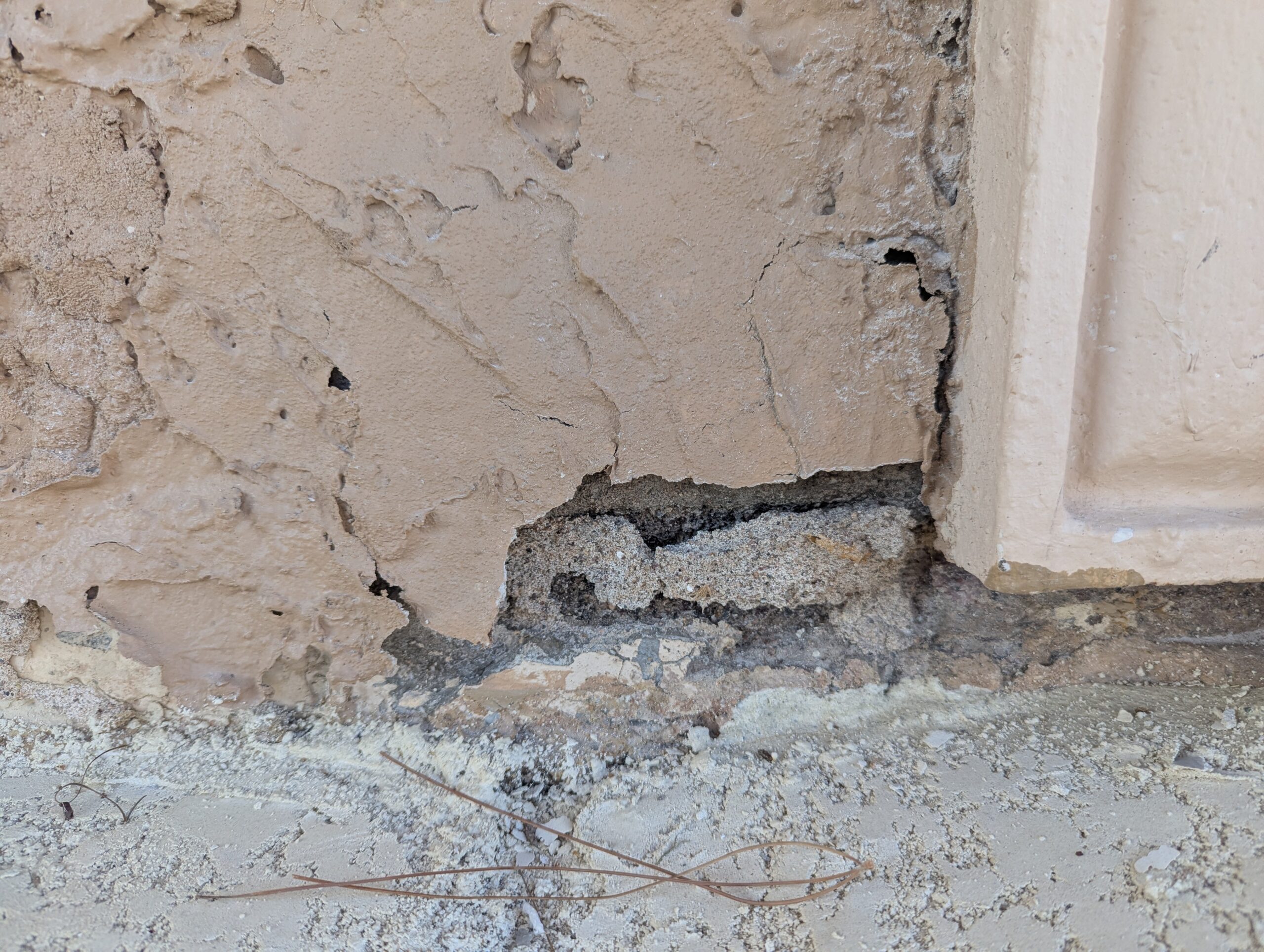
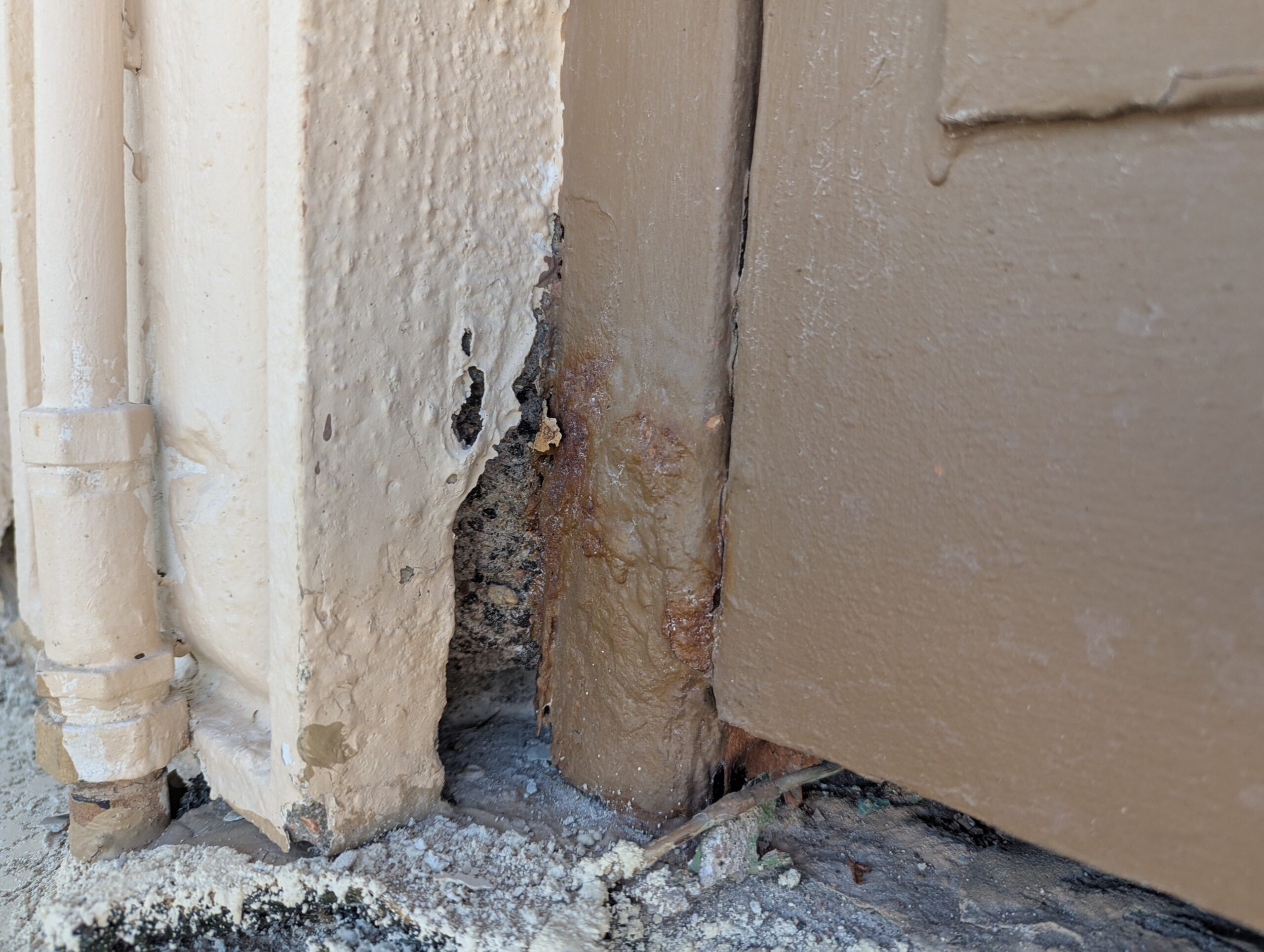
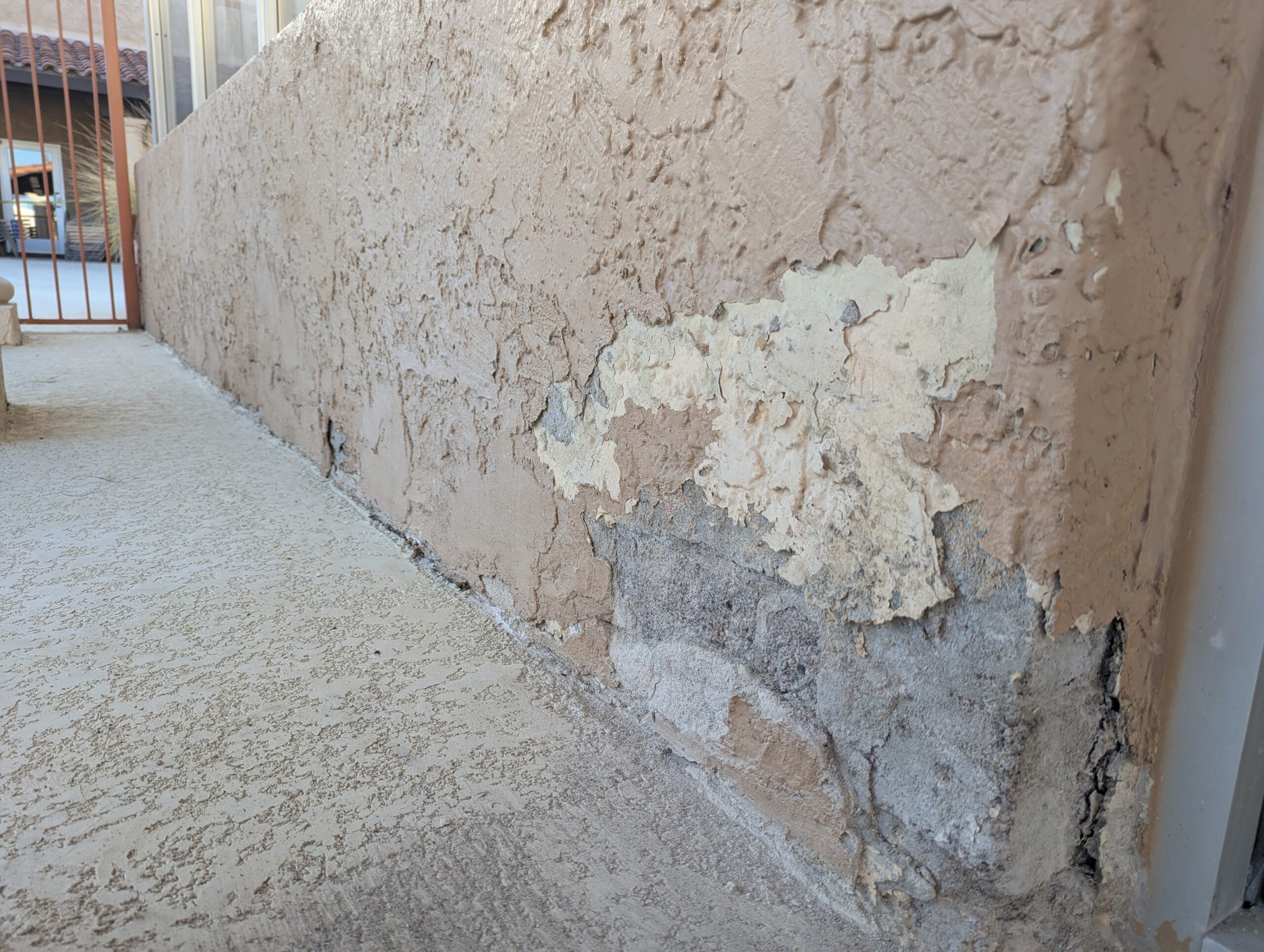
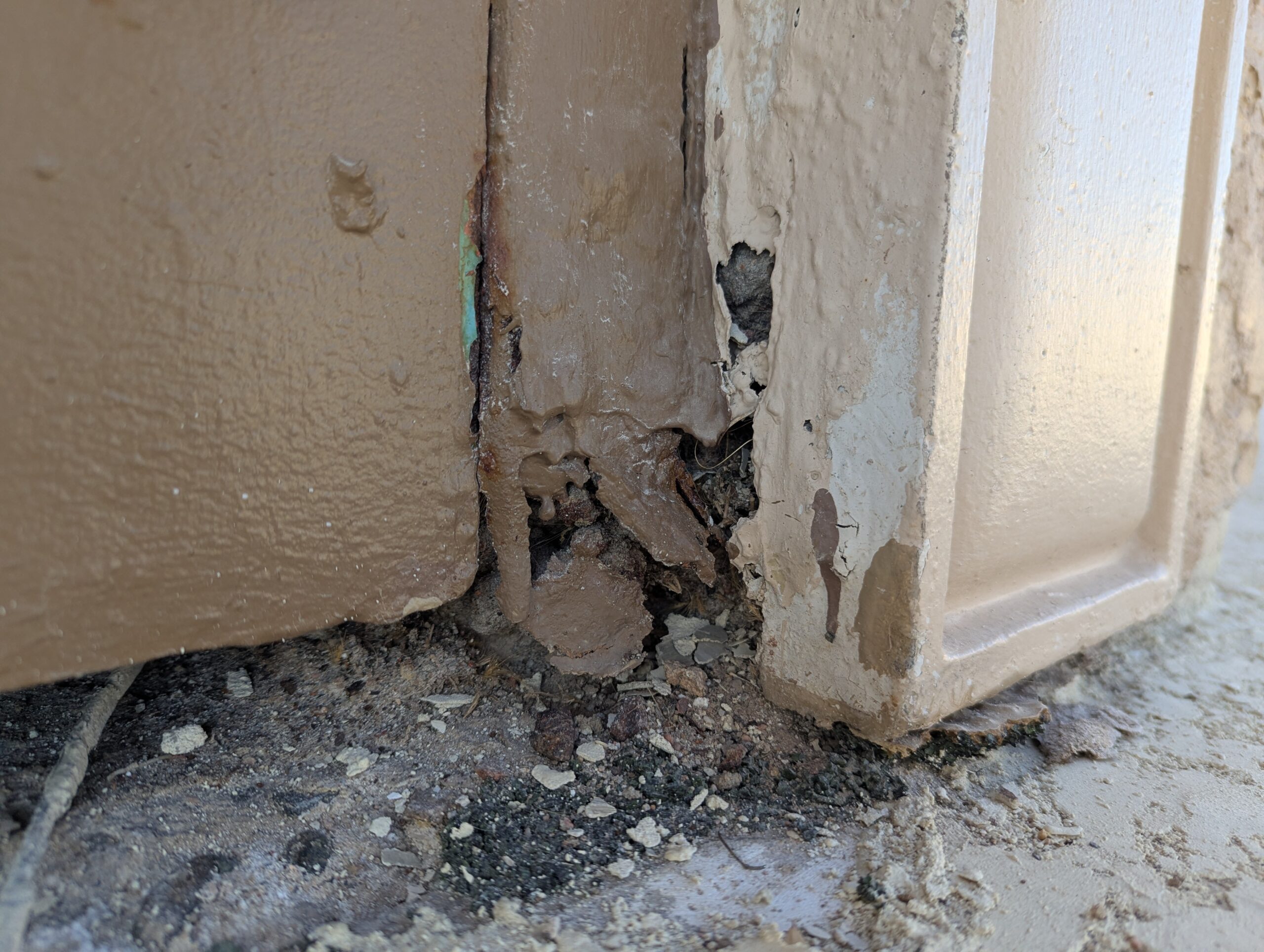
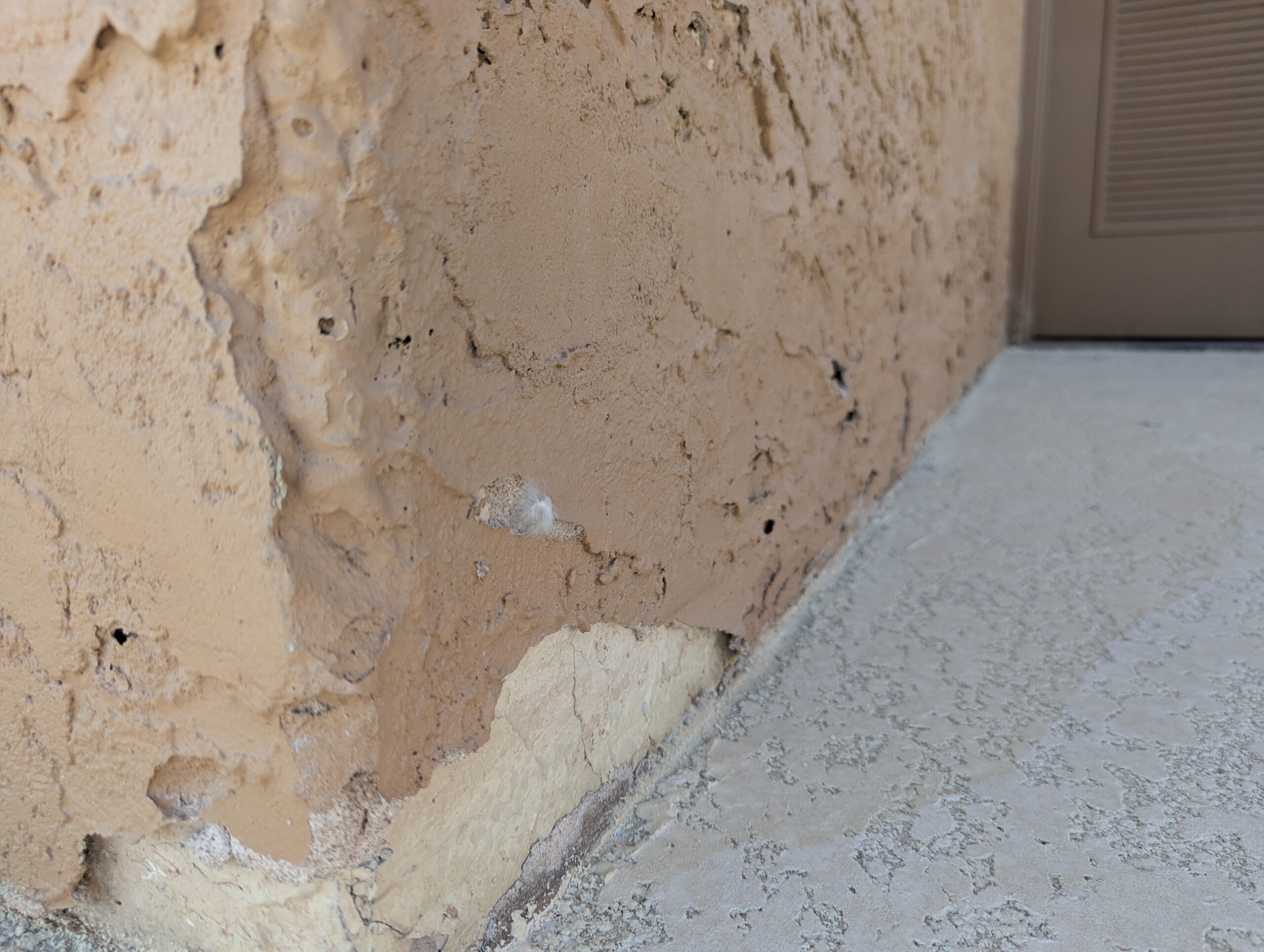
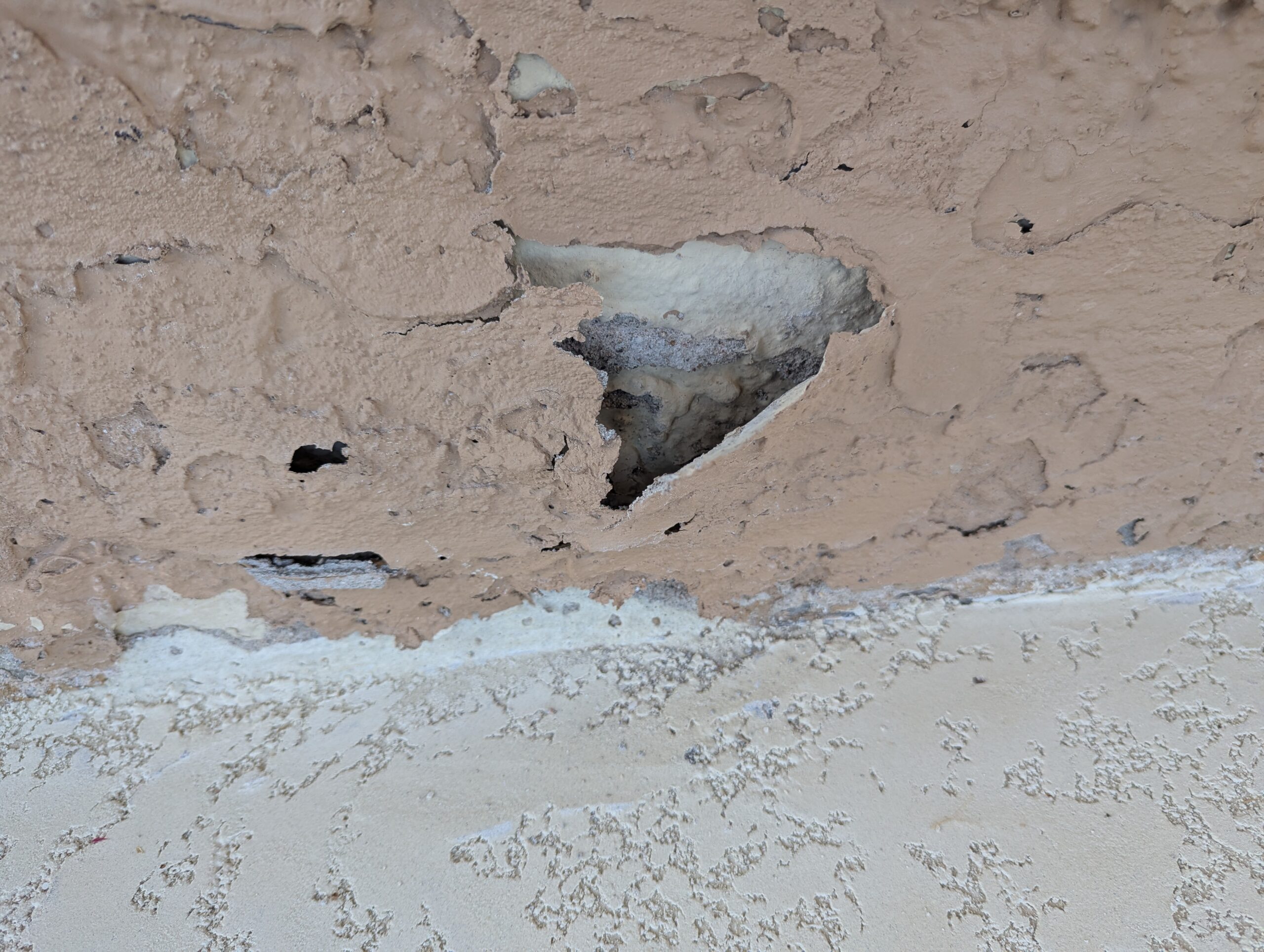
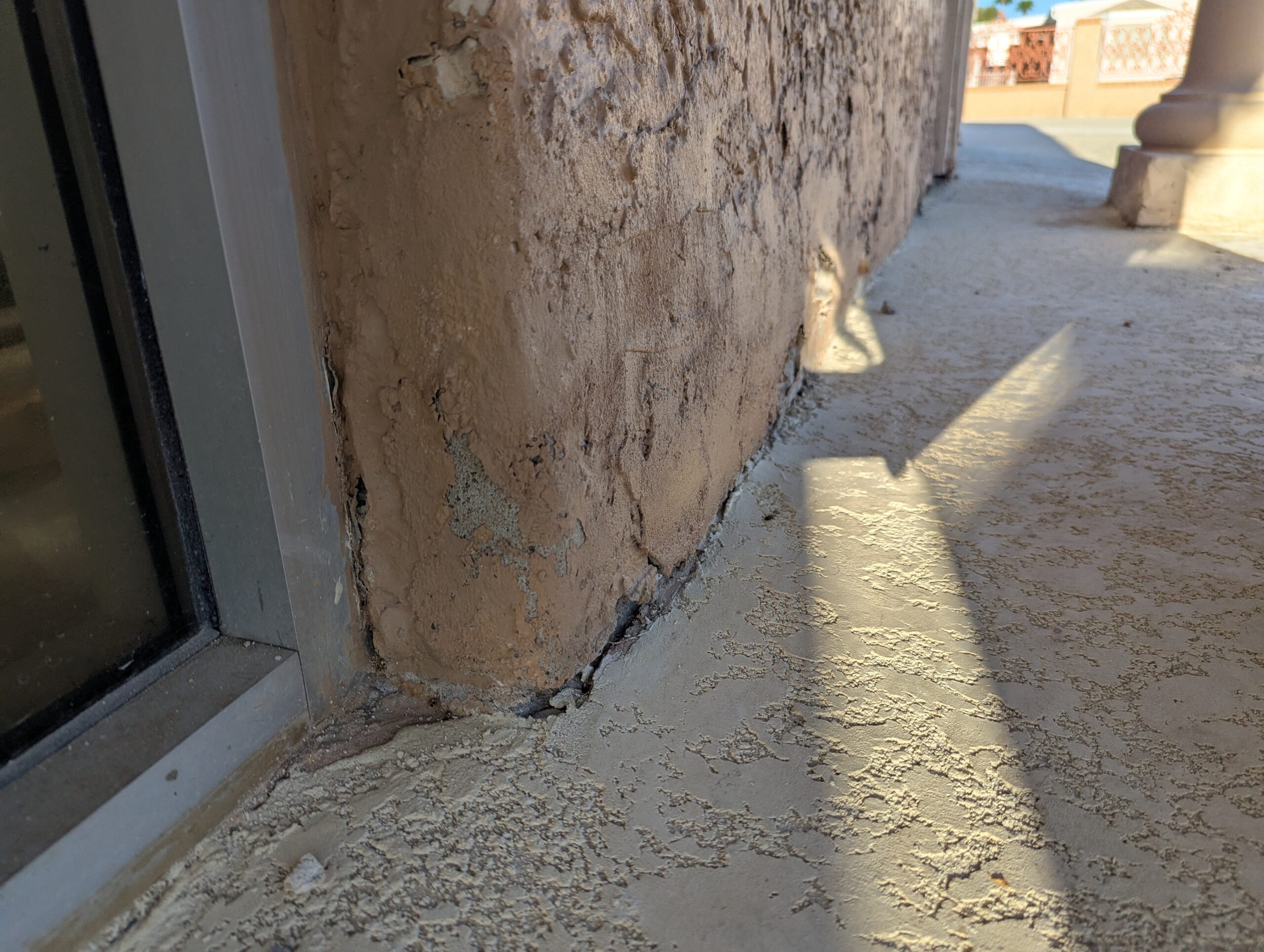
Click an image to enlarge.
Original construction lacks a moisture barrier, allowing water intrusion to corrode rebar and damage walls (similar to current Rec Hall repairs). Installing a barrier will prevent further structural deterioration and reduce future repair costs.
Costs: Phase I Aquatic Building Moisture Barrier $100,000.00
Bridge & Perimeter Wall Evaluations
Professional evaluations are needed to identify cracks, shifting, rust, and stability issues to prevent structural failures and costly emergencies.
Costs:
- Bridge Structural Evaluations $15,000.00
- Block Wall Assessment $14,000.00
Paint & Flooring
Some common area buildings have interior and exterior paint and flooring beyond useful life. Replacement protects surfaces, improves safety, reduces ongoing repairs, and ensures our shared spaces present a clean, well-maintained, and well-cared for appearance.
Costs:
- Exterior Paint Common Area Buildings $76,289.00
- Common Area Flooring – Carpet/Vinyl $29,271.40
Windows & Screens
In some buildings, aging windows and screens have broken seals, drafts, moisture intrusion, and security issues. Replacement improves energy efficiency and safety.
Costs: Windows and Screens $24,005.00
Golf Carts
Maintenance and security carts are heavily used each season, and some have become increasingly unreliable. Replacing them with newer used units improves reliability, reduces downtime, and is more cost-effective than continued repairs.
Costs: Used Golf Carts $38,874.00
Restaurant Equipment
Several pieces of restaurant equipment are approaching the end of their useful life. To ensure continued service reliability, maintain food safety standards, and avoid unexpected failure or costly emergency replacement, these items have been included on the deferred maintenance list. While the long-term future of the restaurant is still under review, planning for equipment replacement protects the Association from operational disruptions and preserves options moving forward.
Costs: $75,381.00
For more discussion on the community’s deferred maintenance and proposed path forward, we encourage you to attend the upcoming Town Hall meetings hosted by the Finance Committee on January 08, February 05, and March 05 at 7PM in the Rec Hall.
Click to view all upcoming meeting schedules.
FAQS: Special Assessment for Deferred Maintenance
In this section you can read through frequently asked questions regarding the proposed Special Assessment for Deferred Maintenance.
If you have any additional questions after review this page, please use the form at the bottom of this page. We’d love to address your questions, concerns, or hear your feedback regarding this or any of the items on the ballot this season.
Why is this work needed now?
Many of the systems included in this plan are already past their expected useful life and are experiencing increasing failures. Delaying repairs often leads to higher costs, safety risks, and service disruptions. Addressing these items now helps prevent emergency repairs, reduces long-term expenses, and protects the community’s infrastructure.
How will these Projects be funded?
During the December 16, 2025 open meeting, the Board approved placing a special assessment measure on the upcoming election ballot. The proposal seeks $3.18 million to fund the full list of deferred maintenance projects; equal to a $3,000 per-lot assessment, payable over three years. Approval requires a two-thirds “yes” vote of those who cast a ballot. If the measure does not pass, the alternative would be annual HOA assessment increases of up to 20% per year until sufficient funding is reached.
Why a special assessment instead of reserves?
Reserves alone are not sufficient to address the accumulated deferred maintenance. This approach allows the community to correct critical issues without depleting reserves needed for future planned replacements.
Why spread the cost over three years?
Phasing the assessment over three years reduces financial impact while allowing projects to be prioritized and completed responsibly.
Will this prevent future assessments?
While we cannot predict the future, or future needs, the goal here is to break the cycle of deferred maintenance. Bringing systems back to a stable condition allows future repairs and replacements to be planned and budgeted rather than handled as emergencies.
Are these upgrades or replacements?
These projects are necessary replacements and repairs, not cosmetic upgrades. Most involve infrastructure and safety-related systems that have reached the end of their useful life or are already failing. This work addresses essential needs required to keep our community operating safely and reliably—not optional improvements or enhancements.
How were priorities determined?
Projects were prioritized based on safety risks, liability exposure, likelihood of failure, impact on daily operations, regulatory requirements, and long-term cost avoidance. Items that pose the greatest risk to resident safety or the Association’s liability, or that could lead to emergency failures and higher costs if delayed, were addressed first.
What role does the reserve study play in deciding what work gets done?
The Association’s reserve study consultant evaluates the condition of major assets every five years, estimates their remaining useful life, and provides long-term cost projections to support planning. Their role is advisory; they do not decide what projects must be completed or when.
YES vs. NO Comparison
| Category | If the Special Assessment PASSES (YES) | If the Special Assessment DOES NOT PASS (NO) |
|---|---|---|
|
Project Timing |
Projects can begin sooner and be completed in a planned, coordinated way |
Projects could be delayed and must wait for funds to accumulate |
|
Cost Control |
Better cost control by avoiding reactive repairs and emergency pricing |
Higher long-term costs due to deterioration, and reactive repairs |
|
Risk of Emergencies |
Lower risk of unexpected failures and emergency repairs |
Higher risk of system failures, service disruptions, and emergency repairs |
|
Financial Predictability |
Clear, capped amount per household ($3,000) with defined end date |
No clear cap; no defined end date |
|
Impact on Assessments |
Temporary assessment that ends once projects are paid for |
Higher increases to quarterly assessments and/or reserve contributions |
|
Reserve Fund Health |
Protects reserve balances and keeps funding aligned with reserve studies |
Continued strain on reserves or need for accelerated contributions |
|
Long-Term Strategy |
Allows the Association to reset and move forward with a plan |
Extends the backlog of deferred maintenance without a clear endpoint |
- What a "Yes" Vote Means
A Yes vote for the special assessment authorizes the Association to move forward with the full deferred maintenance project list now rather than continuing to delay repairs. Dedicated funding would allow the work to be completed within approximately three years, reducing the risk of failures, emergency repairs, and rising costs caused by inflation and further deterioration.
Addressing the backlog in a planned and comprehensive manner helps protect property values, preserve community assets, and avoid escalating problems that become more expensive later. While this assessment focuses on the current backlog, the Association will continue planning for future maintenance needs to ensure long-term stability and responsible asset management.
- What a "No" Vote Means
A No vote for the special assessment does not remove the need to complete the maintenance; the work would still have to be done over time. Without special assessment funding, progress would be slower and projects would be completed only as funds accumulate through annual assessment increases.
This approach increases the likelihood of further deterioration, unexpected failures, and higher total project costs in the future. Funding would need to come from operational and/or reserve increases, which may be adjusted annually, up to 20% per year, until adequate funds are reached.
Payment Options if Passed:
(Projected HOA dues with the special assessment applied)
Quarterly Example*
- Year 1: $1,200/quarter (825 operating + 125 reserve + 250 special)
- Year 2: $1,258/quarter (858 operating + 150 reserve + 250 special)
- Year 3: $1,317/quarter (892 operating + 175 reserve + 250 special)
*Assessments would begin July 1, 2026. Figures shown are estimates assuming a 4% annual operating increase; exact future costs cannot be predicted.
If approved, homeowners would have flexible payment options to choose from based on their financial preference:
- $3,000 one-time lump-sum, or
- $1,000 per year for 3 years, or
- $250 quarterly for 3 years, or
- $83.33 monthly for 3 years
Potential Cost Scenario if Not Passed:
(Example of what may be required to build funding over time)
Quarterly Example*
- Year 1: $1,086/quarter (825 operating + 261 reserve)
- Year 2: $1,303/quarter (858 operating + 445 reserve)
- Year 3: $1,564/quarter (892 operating + 672 reserve)
*Assessments would begin July 1, 2026. Figures shown are estimates assuming a 4% annual operating increase; exact future costs cannot be predicted. The “No” scenario represents one possible funding path and is provided for comparison purposes only.
Meet the Candidates

Dan Borders (Incumbent)
My wife, Chris, and I are originally from Minnesota. We first came to Roadhaven as renters during the 2020–2021 season and purchased our home in January 2021. Family connections brought us here, as my sister and brother also own homes in Roadhaven.
I spent more than 34 years with McDonald’s Corporation, advancing through nearly every level of the organization. My experience includes operations leadership, consulting owner-operators, strategic planning, human resources, training, and profitability. After leaving the corporation, I worked for a McDonald’s owner-operator, helping to grow the business from 10 to 15 restaurants and overseeing operations for approximately 875 employees. I retired at the end of 2024.
Community service has always been important to me. I have coached youth basketball, served on a nonprofit board, led a fundraising tournament that raised nearly $200,000, and volunteer annually with the American Legion.
At Roadhaven, I am active in the Tennis Club and Bocce Ball, help run the tennis fundraiser, and serve as Board liaison to the Recreation Council and Golf Advisory Board. I was appointed to the Roadhaven Board of Directors in the summer of 2024 and am running for my first full term.
I bring strong leadership, operational experience, and a commitment to transparency, respectful discussion, and decisions that support the long-term success of Roadhaven.

Jayne Tiffany (Incumbent)
Jon and I came to Roadhaven and bought here in March of 2018. We fell in love with this place after we took the hospitality tour.
My background is county government, and I ended my working career in the Federal government level.
During my working years I oversaw the Drainage districts, my responsibilities included, hiring, firing of contractors, public hearing, leveeing special assessments, publishing for bids, the separate accounts, taking minutes of meetings and on-site reviews with the contractors. I shared the IT work with another person and maintained the GIS layers and maps for the county. I participated in the State Election classes and became a certified election official. 2 | P a g e
When I was not working, I volunteered for the board of Paws, Greene County Domestic Abuse, my church and political party. I am a member of the Iowa Master Gardeners and the Mississippi River Watershed Committee.
Since being at Roadhaven I have volunteered on the first Communication Committee, Elections and Nominations, substituted on the volunteer security, and the Architecture Office. I am a bingo player, cribbage player, like to tread water, and belong to the Lapidary club.
My hobbies include reading, quilting, cooking, fishing, all things music, and bookkeeping for our farming operation.

Sandra Magnan
I have one son who lives in Oregon and a partner Gary Sholl. I have lived in Roadhaven since 2018.
I am originally from Minnesota, where I spent 30 years working in the Crow Wing County Auditor’s Office, including 25 years as Tax Director, Deputy County Auditor, and Election Coordinator. After retiring in 2003, I moved to Northern California, where I served with AmeriCorps supporting local schools and later worked for the Yuba College system processing financial aid for students.
While living in California, I resided in a large Property Owners Association with 839 residents and served five years on the POA Board as Treasurer. I also served seven years on the governing board of a related nonprofit that managed community amenities, including a clubhouse, bar, kitchen, and swimming pool.
My background includes extensive volunteer and leadership experience. I have served on curriculum and steering committees in Minnesota, participated on a Minnesota State Task Force reviewing electronic voting systems, and served as State Audit Chair for the Minnesota Business and Professional Women. I have also volunteered as a tutor for college students. At Roadhaven, I am actively involved as a Drill Instructor for the Parkettes, a Line Dance Instructor, and the Registrar for the Bocce League.
I am running for the Roadhaven Board because I believe strongly in transparency, consistency, and fair application of rules and regulations. I look forward to working collaboratively with the new management team, value clear communication—especially regarding financial decisions—and am committed to strengthening and nurturing the sense of community that makes Roadhaven such a special place to live.
Meetings Before the Election
All residents are encouraged to attend meetings. In this section you will find a list of when and where these items will continue to be discussed.
Board Meetings
Board of Directors
- Tues., Jan 20, 10AM, Rec Hall
- Tues., Feb 17, 10AM, Rec Hall
Town Halls
Town Halls
- Thurs., Jan 8, 7PM, Rec Hall
- Thurs., Feb 5, 7PM, Rec Hall
- Thurs., Mar 5, 7PM, Rec Hall
Finance Committee
Finance Committee
- Fri., Jan 2, 1PM, Rec Hall
- Fri., Jan 16, 1PM, Rec Hall
- Fri., Feb 6, 1PM, Rec Hall
- Fri., Feb 20, 1PM, Rec Hall
- Fri., Mar 6, 1PM, Rec Hall
Coffee Talk

Questions and answers
Questions submitted by residents in any way, including spelling or grammar.
Purchase of equipment vs. leasing
Q: I am questioning the purchase of equipment rather than leasing (lease cost is a tax deduction and maintenance is included) . This could save going forward. Also this HOA cost level is likely to result in large sales volumes and little interest from new buyers.
A: The Association does evaluate both leasing and purchasing options for equipment to determine which approach best fits the HOA’s operational and financial needs at the time. Leasing can offer advantages such as predictable monthly costs and flexibility if equipment needs change, while purchasing may be more cost-effective over the long term depending on useful life, usage, and total cost of ownership.
When making these decisions, the HOA considers overall financial impact, reserve health, operational risk, and long-term sustainability. Cost control is an important factor, particularly given the Association’s current expense levels and the potential impact on marketability and buyer interest. Our goal is to select the option that best balances fiscal responsibility with reliable service for the community, both now and in the future.
Line of credit
Q: Projects need to be completed. Have we looked at a bank line of credit for maybe 7 plus years for full 3 years needs? We should ask bank for interest only mthly and draw as needed. Provide options to owners to pay up front their full amount or terms for 1-7 years. Owners would pay interest cost on term they decide on. Due to lot sales over 7 years chances are most if not all debt retired or owners may just payoff when personal investments mature and they do not want debt payments. We should at same time build Reserve with easier to accept quarterly HOA dues.
Because these expenses are for past short sighted outlook by well meaning people but have caused current owners ills of the past. No figure pointing but seems fair to say and we need to absorb today at a reasonable figure to not have to much ill will. I believe a number of owners will pay in full or quickly . If they have no interest cost in first 90 days we just borrow less annually. Bank will need to see schedule of repayment plans to support interest only debt but I believe will accept if presented well.
I think the HOA should add an admin cost to term payment plans like 2% annually to offset administration n cost to monitor term payments and again encourage paying off owner amt as soon as possible.
I would like to see this not become a “war” and we make it as financially reasonable while getting things done and build for the future.
A: The Association understands the desire to complete needed projects while remaining mindful of financial impact, owner sentiment, and Roadhaven’s long-standing practice of avoiding long-term debt. Those principles are important, and any funding approach must balance completing necessary work with preserving financial stability and minimizing risk to the HOA as a whole.
At the same time, the Board and management have a fiduciary obligation to carefully evaluate the implications of borrowing, including interest costs, administrative complexity, repayment risk, and long-term effects on reserves and dues. Options such as owner payment plans, reserve funding strategies, and alternative funding structures are being reviewed alongside the goal of avoiding unnecessary debt and maintaining fairness for current and future owners. The objective is to move forward in a way that is financially responsible, transparent, and sustainable while completing the work the community needs and positioning the Association more strongly for the future.
Sports and audits
Q: Perhaps HOA fees should not be allocated to any sports functions, or reduced and those funds go to repairs. Clubs can charge more from participants or hold fundraisers as fees are getting out of control. Also perhaps an audit to review any particular costs that are inappropriate now.
A: The Board and Finance Committee have reviewed operating expenses as part of the deferred maintenance discussion, including how funds are allocated across departments and activities.
As outlined in the materials, the proposed plan focuses on addressing critical infrastructure and safety-related repairs while continuing to evaluate operating costs and reserve funding to ensure long-term sustainability. Ongoing financial reviews, including audits, are part of responsible governance and will remain an available tool and practice as conditions and priorities evolve.
We appreciate the input and the goal of keeping costs reasonable while ensuring the community’s essential needs are met.
Excellent communication
Q: Excellent job on this communication regarding the special assessment. It was very well done. Keep up the good work!
A: Thank you for the kind feedback. We appreciate you taking the time to share it and are glad the information was helpful.
Seasonal residents
Q: Is it cheaper to contract out the maintenance work?rather than keeping full time employees Benefits cost money. When we purchased our property we were under the assumption that this was to be a seasonal 6 month HOA park. Now we have too many full time residence that pay the same HOA fees we do Full time residence should pay more in HOA fees.
Security could be an unmanned gate in off season All facilities should be closed during off season with a skeleton crew to maintain which could be out sourced No admistrativ staff during off season.
Mail services closed from May01- Oct 01 Garbage bins one area only for pick up by the maintenance building. Restaurant close.If it continues to not be a profit centre. Close it and we should not be purchasing equipment. Lease only Contract out security Full time residence can use off site facilities exactly like we do in our homes elsewhere. Outside independent Audit
A: Cost control, staffing levels, contracted services, and operational scope are all topics the Board and Finance Committee continue to evaluate as part of the Association’s ongoing financial review.
The current proposal is focused specifically on addressing deferred maintenance and critical infrastructure needs. Broader operational questions such as staffing models, seasonal service levels, amenities, and fee structures are policy and governance matters that require a separate discussion. Independent financial reviews and audits are established tools that may be used as part of that process.
We appreciate the perspective and the emphasis on long-term sustainability. The idea of having year-round residents pay higher HOA fees has been raised by a few residents in the past; however, it is not permitted under the community’s CC&Rs Section 6.6 Uniform Rate of Assessment: Both annual and special assessments must be fixed at a uniform rate for all Lots and may be collected on a monthly, quarterly, or annual basis, as determined by the Board.
Best Value
Q: We have reviewed the individual projects and costs for special assessment. Although we are in favor of the special assessment we have questions to ensure project decisions lead to best value for the park. Three projects need more information and research done to ensure residents of value for money. 1) Phase 2 pool – pools are most costly amenity. We may need to research if two pools are really necessary for the park to ensure it is providing enough value to warrant ongoing maintenance costs. 2) Golf Course Pond- at over a million dollars it should be ensured that research into whether the need for drainage for the park can be met in an alternative manner that is less costly than the golf pond. Although drainage is required a pond for golf course is not. Alternative drainage options should be identified, costed and shared with residents to ensure the million plus cost is needed. FEMA should have drainage consultants that can provide what is needed to meet drainage requirements that are unrelated to the golf course. 3) Restaurant Equipment – Only if the restaurant can demonstrate it is financially independent over this year and the next two years should any costs for kitchen equipment maintenance or replacement be considered.
A: The Board and Finance Committee understand the importance of ensuring that project decisions are well-supported and represent responsible use of Association funds. The projects referenced in your comments were included in the deferred maintenance plan based on current conditions, safety considerations, and infrastructure requirements outlined in the supporting materials. Questions regarding scope, alternatives, and long-term operational impact are appropriate and are typically evaluated as projects move from planning into execution, particularly for higher-cost items.
With respect to the specific items noted, the Phase 2 pool, golf course pond, and restaurant equipment will continue to be reviewed as part of this process. The golf course pond, in particular, is not a standalone amenity project but part of a larger, professionally prepared drainage study addressing broader park drainage needs. As projects advance, additional analysis may be evaluated and shared where appropriate. Your comments will be included as part of the ongoing review and discussion as the Association continues to evaluate and prioritize these projects to ensure value, compliance, and long-term sustainability for the community.
Reserve study
Q: Is the current reserve study’s available? Has Roadhaven been contributing to the reserve fund as suggested ? So those funds should be paying for what the reserve study’s is showing what is due to fund
A: Yes, the current reserve study is available on the Association portal for owner review. Roadhaven has been contributing to the reserve fund; however, contributions in prior years have not fully met the funding levels recommended in the reserve study. As a result, some reserve components are now coming due without sufficient reserve balances to fully cover them, which is why alternative funding options are being discussed. The reserve study remains the primary planning tool used to identify expected repair and replacement timelines and associated costs. The Board and Finance Committee continue to use this study, along with updated project information, to guide funding decisions and address deferred needs in a responsible and transparent manner.
Phase II Pool
Q: So according to this timeline the phase 2 pool will be closed for 2 years?
How are all the price figures calculated? Actual estimates and how many?
I worked for the federal government for 32 years and I know the ‘government price’ is often a higher price. Like the old saying $50 for a hammer.
A: We are not certain how the conclusion was reached that the Phase II pool would be closed for two years. Under the current plan, if the special assessment is approved, the Phase II pool deck and Pebble Tec work is scheduled to occur in year two of the three-year plan, not over a two-year continuous closure. Any temporary closure would be limited to the summer construction period required to complete that specific scope of work.
Project cost figures are based on pricing provided by professional contractors with experience in similar commercial and HOA projects. Estimates are developed using current market conditions, labor and material costs, and known site requirements. These are not arbitrary or “government pricing,” but contractor-based estimates used to responsibly plan for capital projects. As projects move closer to execution, final scopes and pricing are further refined to ensure accuracy and value for the Association.
Underground sewer
Q: Has there been a study completed on on UNDER GROUND sewer/water piping. Age of system has been “RUMORED” as old possibly a big ticket item needing to be addressed?
Could this be answered? If truly old–do we need to be proactive and address? I am sure costly, however–do you do in stages over 3-4 years. Infrastructure will have a big affect on values for resale/longevity of ownership to Resort. As long as proposing “Special Assessment” might be worth considering adding on list and cost?
A: Thank you for raising this important question. A study of the Association’s underground water and sewer infrastructure is part of our long-term planning strategy. To date, based on inspections, testing, and operational history, we have not identified evidence indicating the need for a large-scale replacement project at this time.
That said, water and sewer lines remain on the Association’s ongoing list of infrastructure items that are regularly monitored to ensure they are functioning properly. If future evaluations indicate emerging issues or the need for proactive work, those findings would be reviewed by the Board and addressed through a phased and financially responsible approach. At present, there is no data supporting the inclusion of a major underground piping project as part of the current special assessment, but this area will continue to be actively evaluated as part of long-term planning.
Reserve Budget
Q: how much is suggested to contribute to the reserve fund on a monthly budget or quarterly ? Have these amounts been deposited into the correct bank account, is there a separate bank account to deposit these funds?Where can I see this amount currenty?
A: The suggested amount depends on which major maintenance items are scheduled for replacement in a given year. For planning purposes, our recommendation to the Finance Committee is to begin funding reserves at $125 per quarter starting in fiscal year 2026–2027, with a $25 per-quarter increase each year for the following four years. Taking this gradual approach allows us to strengthen the reserve fund responsibly while preparing for future repair and replacement needs.
We also want to reassure you that the reserve fund is kept in its own dedicated bank account, completely separate from operating funds. All reserve contributions have been deposited accordingly, and these balances can be viewed at any time on the Association’s balance sheet available through the owner portal.
Our goal is to ensure transparency, thoughtful planning, and long-term financial stability for our community.
Lake Liner
Q: On the issue of the lake liner … is it really necessary to have a lake that retains water as part of the north park water control. Couldn’t this area be “xeriscaped” as a “rough” area on the golf course and still fulfill it’s job for water control. Seems like this option would be significantly less expensive and if done well would be compatible with both the golf course and the water control system. Yes it would be “change” but might be acceptable as an alternative.
A: The lake in the north park is not simply a golf course feature—it is a designed and engineered component of Roadhaven’s overall stormwater and floodplain management system. Its purpose is to retain, control, and release stormwater in a specific way during both normal conditions and major rain events. A water-retaining basin behaves very differently than a dry or xeriscaped area, particularly in how it manages volume, flow rate, soil stability, and downstream impacts.
Converting the lake to a dry, xeriscaped “rough” area would require a complete redesign of the drainage system, including new hydrology and hydraulic studies, re-engineering the basin, and obtaining approvals from regulatory agencies that oversee drainage and floodplain compliance. There is no guarantee such a redesign would be approved, and even if it were, the cost of engineering, permitting, reconstruction, and risk mitigation could rival—or exceed—the cost of repairing the existing system.
Additionally, a dry basin introduces its own challenges, including erosion control, sediment buildup, slope stability, and maintenance issues that can impact both drainage performance and the golf course over time. From a risk, compliance, and cost-control standpoint, maintaining the system as it was originally designed and approved is the most predictable and responsible option.
While change can sometimes be a good thing, in this case maintaining a functional, engineered water-retention lake is necessary to ensure proper stormwater control, protect surrounding infrastructure, meet regulatory requirements, and avoid greater costs and risks in the future.
CC&R changes
Q: The link to the CCRs goes to the CCRs. Where are the proposed changes to such?
A: Thank you for your question. Please visit the Elections page on the Roadhaven website at https://roadhaven.com/election/. This page contains all information related to the upcoming election. The language for the proposed changes is currently under legal review and will be added to the page on January 30, when ballots are mailed and electronic voting opens.
Increases
Q: Will there be an increase to the HOA on top of the Special assessment?
A: HOA fees and the special assessment are separate matters. Our operating budget is still being finalized and will continue to be refined through early February. Any change to HOA fees will reflect only the actual cost of keeping the resort running next season.
Independent business
Q: Thank you for the information. We appreciate the hard work that goes into running the park.
Reading the estimates, between the golf course and restaurant the approximate cost is $200,000. My question is why are these two not being ran as an independent business? If they cannot maintain their own operating expenses why have them?
A: Thank you for your thoughtful question and for acknowledging the work that goes into operating the community.
The golf course and restaurant are not independent businesses; they are amenities of the Roadhaven resort and are part of the Association’s Common Areas. As such, they are owned and maintained by the Association, not operated as stand-alone commercial enterprises.
This is addressed in the CC&Rs. Section 2.6, Common Area Undivided, states that the Common Area shall remain undivided and shall at all times be owned by the Association. In addition, Section 6.2, Purpose of Assessments, explains that assessments are levied exclusively to promote the recreation, health, safety, and welfare of the Owners and for the improvement and maintenance of the Common Area.
Because the golf course and restaurant are Common Area amenities intended to serve the community, their operating and maintenance costs are funded through the Association rather than through independent business revenue. Their purpose is to enhance resident use, enjoyment, and the overall value of the resort, not to function as profit-driven operations.
Many repairs
Q: Why, so many repairs needed to be done. These in items should be checked at least a couple times a year. It’s hard to believe all of sudden this many repairs.
Does the restaurant make any money at all. If it doesn’t make enough money that it can’t help pay for expenses it needs to go! You need to find ways to save money, instead of raising HOA all the time. Not all of us have that kind of money laying around. Not when I have to still work 12 hours a day !
A: Thank you for sharing your concerns, we understand how frustrating rising costs can be, especially for residents who are still working long hours.
While it may seem sudden, many of the repairs being identified now are the result of deferred maintenance over several years. As equipment ages, multiple issues tend to surface at the same time. These items have been inspected, but inspections don’t prevent aging systems from eventually needing repair or replacement.
The restaurant is not a stand-alone business; it is a community amenity and part of the Association’s common areas. Its purpose is to serve residents and enhance the overall community experience, not to operate as a profit center.
The Board is actively focused on controlling costs while also meeting its responsibility to maintain the community and avoid larger, more expensive problems in the future.